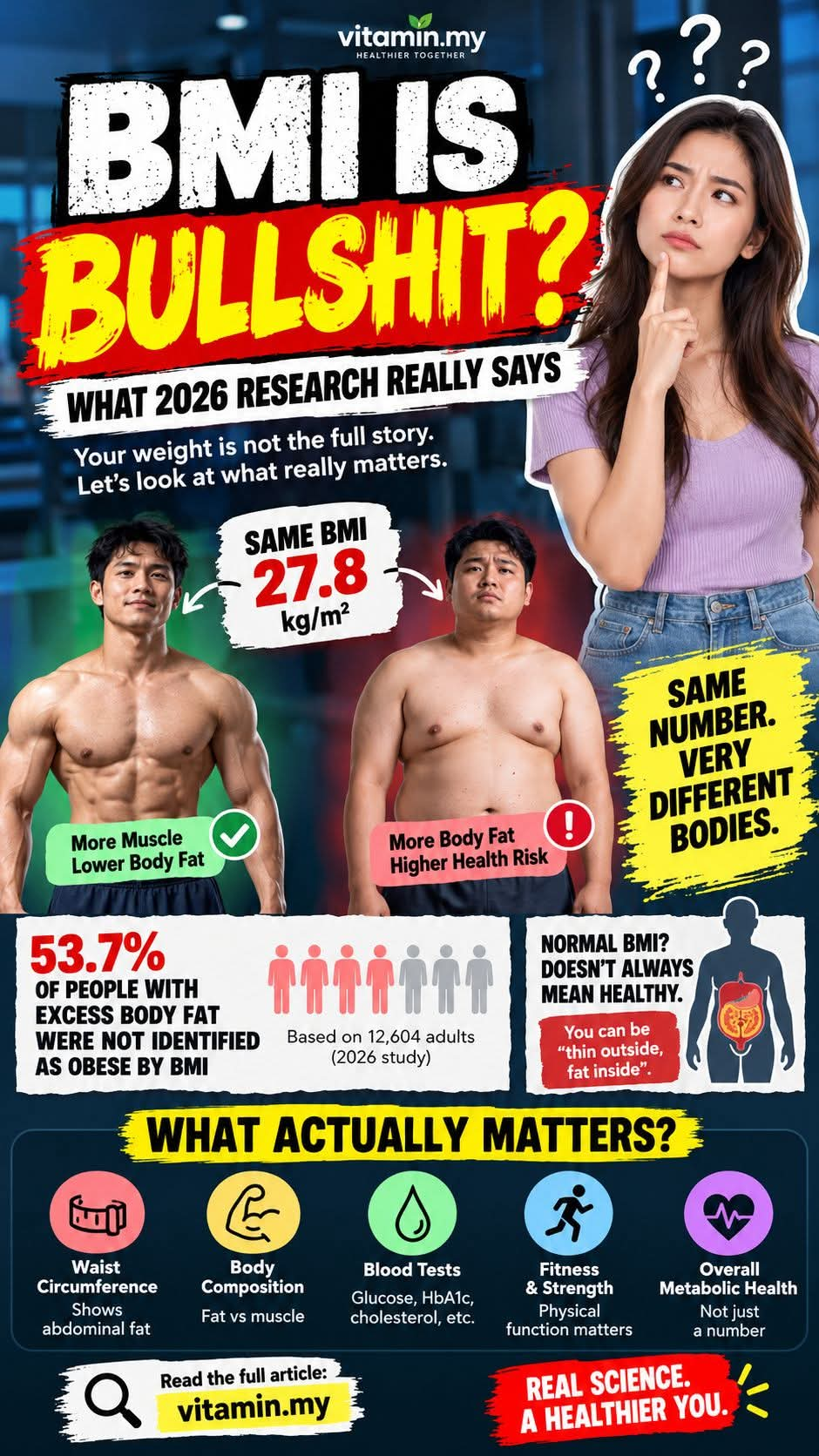
For decades, one number has dominated the way we talk about body weight: BMI.
Walk into a clinic, join a weight-loss programme, undergo a health screening, apply for certain insurance policies, or simply use an online health calculator and you may immediately be classified as:
Underweight. Normal. Overweight. Obese.
The calculation is incredibly simple:
BMI = body weight in kilograms ÷ height² in metres
A person who weighs 80 kg and is 1.70 metres tall has a BMI of approximately 27.7 kg/m².
According to the conventional classification, that person is overweight.
But here is the problem.
What exactly do we know about that person’s body from the number 27.7?
Do we know how much muscle they have?
No.
Do we know how much body fat they have?
No.
Do we know where that fat is stored?
No.
Do we know whether they have large amounts of visceral fat surrounding the liver and other organs?
No.
Do we know whether their blood glucose, triglycerides, blood pressure or insulin sensitivity are healthy?
Again, no.
And this is where the provocative phrase “BMI is bullshit” begins to make sense.
Not because BMI has absolutely no scientific value.
It does.
BMI remains useful for population-level research and as a quick, inexpensive screening tool.
The real problem begins when BMI is treated as if it were a direct measurement of obesity, body fatness or metabolic health.
By 2026, obesity science has moved considerably beyond that idea.
Modern obesity guidelines increasingly recognise that obesity is fundamentally a disease of excess or dysfunctional adipose tissue, not simply a disease of weighing too much.
The 2026 Standards of Care in Overweight and Obesity explicitly state that BMI does not directly assess body composition or body-fat distribution and can both overestimate and underestimate adiposity depending on the person.
So perhaps the question should not be:
“What is your BMI?”
The better question is:
“What is actually making up your weight, where is your fat stored, how much muscle do you have, and what is happening metabolically inside your body?”
That is a very different conversation.
BMI Was Never Designed to Tell Your Whole Health Story
BMI originated from the work of Belgian mathematician and statistician Adolphe Quetelet in the nineteenth century.
The calculation later became widely used because it offered something extremely attractive to researchers and health systems:
simplicity.
You only need two measurements:
weight and height.
No expensive scan.
No laboratory test.
No body-fat measurement.
No sophisticated equipment.
That makes BMI extremely useful when studying thousands or millions of people.
If researchers want to compare obesity trends between populations, BMI provides a convenient standardised measurement.
And statistically, BMI does correlate with body fat and disease risk across large populations.
That part should not be ignored.
The problem is that population statistics do not automatically become precise diagnostic tools for individuals.
Imagine saying that the average Malaysian man is a certain height.
That statistic may accurately describe the population.
It does not mean every Malaysian man is that height.
BMI works in a similar way.
At population level, higher BMI tends to correlate with higher adiposity.
At individual level, however, two people with exactly the same BMI can have remarkably different bodies.
That distinction is becoming increasingly important.
Problem No. 1: BMI Cannot Tell Muscle From Fat
Suppose two men are both 175 cm tall and weigh 85 kg.
Their BMI is identical:
approximately 27.8 kg/m².
Both would traditionally be labelled overweight.
But imagine the first man regularly performs resistance training.
He has large thighs, strong glutes, developed shoulders and substantial skeletal muscle.
His body-fat percentage is relatively low.
The second man has very little muscle, works at a desk all day and carries most of his excess weight around his abdomen.
Same height.
Same weight.
Same BMI.
Completely different body composition.
BMI cannot see the difference.
Muscle contributes to body weight just as fat does.
Bones contribute weight.
Body water contributes weight.
Organs contribute weight.
Yet BMI combines all these tissues into one number.
This explains why muscular athletes can easily enter the “overweight” category despite having relatively low body fat.
Modern obesity guidelines therefore caution against diagnosing excess adiposity solely from BMI when high muscle mass is suspected. The 2026 obesity Standards of Care recommend considering waist measurements or direct body-composition methods such as bioelectrical impedance analysis or DXA in such situations.
This is not merely an athlete problem.
It also matters for ordinary adults.
Two people weighing 70 kg may contain very different proportions of:
- skeletal muscle,
- subcutaneous fat,
- visceral fat,
- bone,
- water.
Weight tells us the total.
BMI adjusts that total for height.
Neither tells us what the total is made of.
The 2026 Evidence: BMI Can Miss More Than Half of People With Excess Body Fat
One of the most interesting studies published in 2026 directly compared BMI classification with body-fat assessment.
Researchers analysed body-composition data from 12,604 adults from Chile and Mexico.
Obesity was classified in two different ways:
BMI-based obesity and body-fat-percentage-based obesity measured using bioelectrical impedance analysis.
The agreement was far from perfect.
BMI had a sensitivity of only 46.3% for detecting adiposity-defined obesity.
In other words, among people who had obesity according to their measured body-fat percentage, BMI failed to identify a substantial proportion of them.
Specificity, however, was very high at 96.9%.
This illustrates something important:
BMI is often better at confirming obvious high-weight obesity than it is at detecting hidden excess fat.
The researchers found that 53.7% of BIA-defined obesity cases were not identified by BMI criteria.
Among people whose BMI was below 25, normal-weight obesity was identified in 16.2% of women and 4.6% of men in the study population.
At the same time, the opposite problem also existed.
Some people—particularly men—had elevated BMI but body-fat percentages below obesity thresholds.
Researchers found substantial overlap in body-fat percentage across BMI categories.
That is exactly why saying:
“Your BMI is 27, therefore you have too much body fat”
can be scientifically problematic.
The BMI may be correct.
Or it may not.
You need additional information.
Problem No. 2: “Normal BMI” Does Not Guarantee Healthy Body Fat
There is another side of the BMI problem that may be even more important.
Some people are relieved when they calculate a BMI of 21, 22 or 23.
They assume:
“My BMI is normal, therefore I am healthy.”
Not necessarily.
A person can have a normal body weight while carrying:
- relatively high body fat,
- low skeletal muscle mass,
- excess abdominal fat,
- excess visceral fat,
- poor insulin sensitivity.
This phenotype is often described as normal-weight obesity.
The popular term “TOFI” — Thin Outside, Fat Inside — describes a related concept.
The person may not look obese.
Their weight may appear perfectly acceptable.
Their BMI may sit comfortably in the “normal” category.
Yet metabolically they may have characteristics usually associated with obesity.
This becomes particularly important with age.
Someone may weigh exactly 65 kg at age 25 and again weigh 65 kg at age 50.
The bathroom scale says:
“No change.”
BMI says:
“No change.”
But the body may have changed dramatically.
Imagine that over 25 years the person lost 6 kg of muscle and gained 6 kg of fat.
Body weight remains 65 kg.
BMI remains identical.
Body composition is completely different.
This is one reason why protecting muscle becomes increasingly important during middle age and later life.
The Fat That Matters Most May Not Be the Fat You Can See
Even measuring total body-fat percentage does not give the whole picture.
Where fat is stored matters.
Human fat is not one uniform tissue.
Two important categories are:
Subcutaneous fat — fat stored underneath the skin.
Visceral fat — fat stored deeper inside the abdominal cavity around internal organs.
Visceral adiposity is particularly important because it is strongly associated with metabolic dysfunction.
Excess visceral and ectopic fat can be associated with:
- insulin resistance,
- type 2 diabetes,
- fatty liver disease,
- abnormal triglycerides,
- hypertension,
- cardiovascular disease.
This explains why waist measurements can sometimes provide information BMI misses.
A person weighing 75 kg with a relatively small waist may have a very different risk profile from another person weighing 75 kg whose fat is concentrated around the abdomen.
Same weight.
Same height.
Same BMI.
Different fat distribution.
Modern obesity science therefore increasingly combines BMI with measures of central adiposity rather than treating BMI as a standalone diagnosis.
Problem No. 3: BMI Can Be Particularly Misleading in Asian Populations
This issue is especially relevant for Malaysians.
Asian populations frequently develop metabolic complications at lower BMI values compared with many Western populations.
A 2026 review in Nature Reviews Endocrinology highlighted several characteristics frequently observed across Asian populations, including greater visceral and ectopic fat accumulation, lower beta-cell reserve and increased cardiometabolic risk at comparatively lower BMI levels. The authors argued for moving beyond BMI-centred definitions toward assessments incorporating adiposity and actual disease.
This helps explain why Asian BMI thresholds used clinically can differ from conventional international cut-offs.
Under the 2026 obesity Standards of Care, an Asian adult with a BMI of 23–27.4 kg/m² may require further assessment for central adiposity, while 27.5 kg/m² is used as an obesity threshold in the relevant framework.
Compare that with the traditional international threshold of BMI 30 for obesity.
That difference is significant.
A Malaysian adult with a BMI of 28 might see a Western BMI chart online and think:
“I am only overweight.”
Yet using Asian-specific assessment, that person may already meet an obesity threshold.
This is one reason blindly applying one universal BMI number to everybody can be misleading.
Malaysia’s Own 2026 Research Shows Why We Need More Than BMI
The argument is not merely theoretical.
Malaysian researchers are investigating this exact problem.
A 2026 study involving Malaysian healthcare workers examined 297 adults with BMI ≥23 kg/m² who did not have previously known cardiometabolic disease.
Researchers assessed far more than BMI.
They measured:
- waist circumference,
- hip circumference,
- neck circumference,
- fat mass,
- fat-free mass,
- glucose,
- lipids,
- blood pressure.
Only 33.67% of participants were classified as metabolically healthy overweight/obesity.
As BMI increased, metabolic abnormalities became considerably more common; among participants with BMI ≥30 kg/m², 85.32% were metabolically unhealthy under the study definition.
Interestingly, BMI, waist circumference, hip circumference and waist-to-height ratio all correlated strongly with fat mass.
So this study does not demonstrate that BMI is meaningless.
Quite the opposite.
BMI still carried useful information.
But metabolic health could not be adequately described by BMI alone.
That is the central message.
Another 2026 Malaysian analysis examining sarcopenic obesity found women with the sarcopenic-obesity phenotype could have lower body weight and BMI despite having similar visceral fat area, percentage body fat and HbA1c compared with women without that phenotype.
Researchers concluded that BMI alone might not adequately characterise metabolic risk across different obesity phenotypes.
This is particularly important after 40.
Why?
Because ageing is often accompanied by gradual muscle loss.
BMI may remain relatively unchanged while the ratio between muscle and fat gets progressively worse.
Sarcopenic Obesity: When You Have Too Much Fat and Too Little Muscle
One of the biggest developments in modern obesity science is greater recognition of sarcopenic obesity.
Traditionally, people imagined obesity as simply carrying too much body weight.
Sarcopenic obesity adds another dimension:
too much fat combined with inadequate skeletal muscle.
This combination matters because muscle is not just something bodybuilders care about.
Skeletal muscle is a major metabolic organ.
It participates in glucose disposal.
It influences insulin sensitivity.
It affects physical function.
It supports mobility and independence as we age.
A Malaysian study published in Frontiers in Nutrition in June 2026 examined sarcopenic obesity using body-composition measurements. Under the study’s specific criteria, approximately one-quarter of the obese Malaysian adults studied met its sarcopenic-obesity definition. The authors stressed that body-composition monitoring can reveal information not adequately captured by simple body-size measurements.
Again, this highlights a simple truth:
Weight is not body composition.
And BMI is fundamentally a measurement derived from weight.
The Biggest Mistake: Treating BMI as a Health Score
Perhaps the biggest problem with BMI is not the formula itself.
The problem is how people interpret it.
BMI was never capable of summarising your entire health status.
Yet psychologically, people often treat it as a score.
BMI 21?
“Healthy.”
BMI 27?
“Unhealthy.”
BMI 31?
“Very unhealthy.”
Human physiology is far more complicated than that.
A person with BMI 27 who:
- resistance trains three times per week,
- has substantial muscle mass,
- has a moderate waist circumference,
- has normal blood pressure,
- has normal fasting glucose,
- has normal HbA1c,
- has healthy triglycerides,
- has good cardiorespiratory fitness,
cannot meaningfully be described by BMI alone.
Likewise, someone with BMI 22 who:
- carries large amounts of visceral fat,
- has very little muscle,
- is physically inactive,
- has elevated blood pressure,
- has insulin resistance,
- has high triglycerides,
should not assume that their “normal BMI” means everything is fine.
This is why the obesity field is shifting from simply asking:
“How heavy are you?”
toward:
“How much excess adiposity do you have, where is it stored, and is it affecting your health?”
A 2026 synthesis of contemporary obesity guidelines described this broader transition, noting that major professional organisations increasingly incorporate measures of adiposity and obesity-related organ dysfunction rather than relying exclusively on BMI.
So Should We Throw BMI Away?
No.
That would be an overreaction.
BMI survives for good reasons.
It is:
- extremely cheap,
- fast,
- easy to calculate,
- reproducible,
- useful for population surveillance,
- associated with disease risk at the population level.
If you are studying obesity trends among one million people, performing DXA scans on everyone would be unrealistic.
BMI becomes extremely useful.
The mistake is expecting BMI to answer questions it was never designed to answer.
Think of BMI as a smoke alarm, not a complete fire investigation.
It tells you:
“Something may be worth looking at.”
It does not tell you exactly what is burning, where the fire is, how large it is or how much damage has occurred.
The 2026 Standards of Care reflect exactly this philosophy: BMI can be used for screening, but additional anthropometric or body-composition assessment may be needed for diagnosis and risk assessment.
What Should You Measure Instead?
There is no single perfect replacement for BMI.
A better approach is to use several measurements together.
1. Waist Circumference
Waist circumference provides information about central adiposity.
For Asian adults, the 2026 obesity Standards of Care cite central-obesity waist thresholds of approximately:
Men: ≥90 cm
Women: ≥80 cm
in the relevant diagnostic framework.
Someone with a BMI of 23 and a rapidly expanding waist may deserve more attention than someone whose BMI alone suggests everything is normal.
2. Waist-to-Height Ratio
Waist-to-height ratio compares abdominal size with stature.
It provides another simple estimate of central adiposity.
Unlike BMI, it at least asks:
Where is some of that mass located?
This does not make it perfect.
But combined with BMI, it gives more context.
3. Body-Fat Percentage
Body-fat measurements attempt to distinguish fat from lean tissue.
Methods include:
- bioelectrical impedance analysis,
- skinfold assessment,
- air-displacement methods,
- DXA.
Every technique has limitations.
Even BIA readings can change depending on hydration, recent exercise, food intake and device quality.
But body-fat assessment answers a question BMI cannot:
How much of the body is actually fat?
4. Skeletal Muscle Mass
This measurement may become increasingly important as you get older.
When someone is trying to lose weight, the goal should rarely be simply:
“Make the scale go down.”
You ideally want to reduce excess fat while preserving as much useful lean tissue and muscle as possible.
A person who loses 10 kg consisting of:
8 kg fat + 2 kg lean tissue
has achieved something very different from someone losing:
4 kg fat + 6 kg lean tissue.
Both lost 10 kg.
BMI cannot tell the difference.
5. Blood Pressure
Body shape is only one part of health.
Blood pressure provides direct information about cardiovascular function and risk.
Someone’s BMI may be unremarkable while hypertension quietly develops.
6. Glucose and HbA1c
Fasting glucose and HbA1c help identify abnormalities in glucose regulation.
Again, these are physiological measurements.
BMI merely estimates risk indirectly.
7. Lipid Profile
Triglycerides, HDL cholesterol, LDL cholesterol and related markers provide additional information about cardiometabolic health.
They tell us what is happening metabolically rather than simply estimating health from body size.
8. Fitness and Strength
Two people with identical BMI can have radically different:
- aerobic fitness,
- muscular strength,
- balance,
- mobility,
- physical capacity.
These differences matter enormously for long-term health.
Grip strength, walking ability, resistance-training performance and cardiorespiratory fitness tell us things BMI never could.
For People Over 40, Body Composition Becomes Even More Important
This deserves special emphasis.
Many people enter their forties focusing entirely on losing kilograms.
That can become a mistake.
Muscle preservation becomes increasingly important with age.
If you diet aggressively, perform little resistance training and eat inadequate protein, your body weight may fall while muscle mass also declines.
The weighing scale celebrates.
BMI improves.
Your body composition may not improve nearly as much as you think.
Consider this example.
Before dieting
Weight: 80 kg
Fat mass: 28 kg
Lean mass: 52 kg
After poor-quality weight loss
Weight: 70 kg
Fat mass: 23 kg
Lean mass: 47 kg
You lost 10 kg.
But only 5 kg came from fat.
The remaining 5 kg came from lean tissue.
Now consider another person.
After better-quality weight loss
Weight: 73 kg
Fat mass: 21 kg
Lean mass: 52 kg
That person only lost 7 kg on the scale.
But all 7 kg came from fat in this simplified example while lean mass was maintained.
BMI would celebrate the larger numerical weight loss.
Body composition might favour the second outcome.
This is why chasing the lowest possible BMI can be the wrong objective.
The Bathroom Scale Is Not the Enemy Either
Just as BMI should not be completely discarded, body weight should not be ignored.
Weight trends remain useful.
If someone gradually gains 15 kg over several years and waist circumference expands significantly, that information matters.
The problem is obsession with a single number.
Your bathroom scale tells you gravitational mass.
It does not tell you:
how much muscle you gained,
how much fat you lost,
where your fat is stored,
whether your liver fat improved,
whether your blood pressure improved,
whether your insulin sensitivity improved,
or whether you became stronger.
Health is multi-dimensional.
Our measurements should reflect that.
A Better 2026 Health Dashboard
Instead of asking only:
“What is my BMI?”
consider tracking a small dashboard.
Body size
- body weight
- BMI
Central fat
- waist circumference
- waist-to-height ratio
Body composition
- body-fat percentage
- skeletal muscle mass
Metabolic health
- blood pressure
- fasting glucose
- HbA1c
- triglycerides
- HDL and LDL cholesterol
Physical capacity
- strength
- walking ability
- aerobic fitness
- daily physical activity
Now you have something far more useful than one height-to-weight equation.
Final Verdict: BMI Is Not Bullshit — Using BMI Alone Is
So is BMI bullshit?
Scientifically, the answer needs nuance.
BMI is not useless.
It remains a valuable epidemiological and screening tool.
But treating BMI as a complete measurement of individual obesity, body composition or metabolic health is increasingly difficult to defend.
The research available in 2026 makes the limitation clearer than ever.
BMI cannot reliably distinguish:
fat from muscle.
It cannot show:
visceral fat from subcutaneous fat.
It cannot identify:
low muscle mass.
It cannot fully accommodate:
age-related body-composition change.
It can underestimate risk:
in Asian populations and people with normal-weight obesity.
And it cannot tell us:
whether excess adiposity is already producing metabolic disease.
Modern obesity assessment is therefore moving toward a broader model involving body composition, fat distribution, metabolic markers and actual functional health.
For Malaysians and other Asian populations, this shift is particularly important because metabolic disease can emerge at comparatively lower BMI levels.
So the next time an online calculator announces:
“Congratulations, your BMI is normal.”
do not panic.
But do not celebrate too early either.
And if it says:
“You are overweight.”
do not immediately assume that a single number has perfectly diagnosed your health.
Ask better questions.
How big is your waist?
How much body fat do you carry?
How much muscle do you have?
Where is the fat stored?
What is your blood pressure?
What are your glucose and lipid markers doing?
Are you becoming stronger or weaker as you age?
Because your health is not a number produced by dividing kilograms by metres squared.
Your body is far more complicated than your BMI.
And in 2026, the science is finally treating it that way.
Key 2026 Research Used in This Article
Standards of Care in Overweight and Obesity—2026
The guideline recognises BMI as a useful screening measure but stresses that it does not directly measure adiposity or fat distribution and recommends additional waist or body-composition assessment when appropriate.
Body Mass Index Underestimates Excess Adiposity — Frontiers in Endocrinology, 2026
Analysis of 12,604 adults found BMI sensitivity of only 46.3% for adiposity-defined obesity, while specificity was 96.9%. Normal-weight obesity was particularly apparent among women.
Clinical Obesity in Asian People — Nature Reviews Endocrinology, 2026
The paper argues that Asian populations require an approach going beyond BMI because visceral and ectopic adiposity and cardiometabolic disease can occur at comparatively lower BMI levels.
Anthropometric and Body Composition Determinants of Metabolic Health in Malaysian Healthcare Workers — BMC Endocrine Disorders, September 2026
This Malaysian study demonstrated considerable variation in metabolic health among adults with elevated BMI and examined waist measurements, body composition, blood pressure, glucose and lipids alongside BMI.
Sarcopenic Obesity in a Malaysian Population — Frontiers in Nutrition, 2026
The study highlights the value of assessing the relationship between fat and skeletal muscle rather than relying entirely on total body weight.
Limitations of BMI in Characterising Obesity Phenotypes — Malaysian 2026 Data
A Malaysian cohort showed similar adiposity and glycaemic measurements in women with sarcopenic-obesity phenotype despite substantially different BMI and body weight, reinforcing the limitations of BMI as a standalone measure.
Health information in this article is educational and should not replace individual medical assessment.
