Behind every great company there is usually a story.
But the story of Shaklee did not begin with a factory, a marketing plan, a bottle of supplements, or even a company.
It began with a sick child.
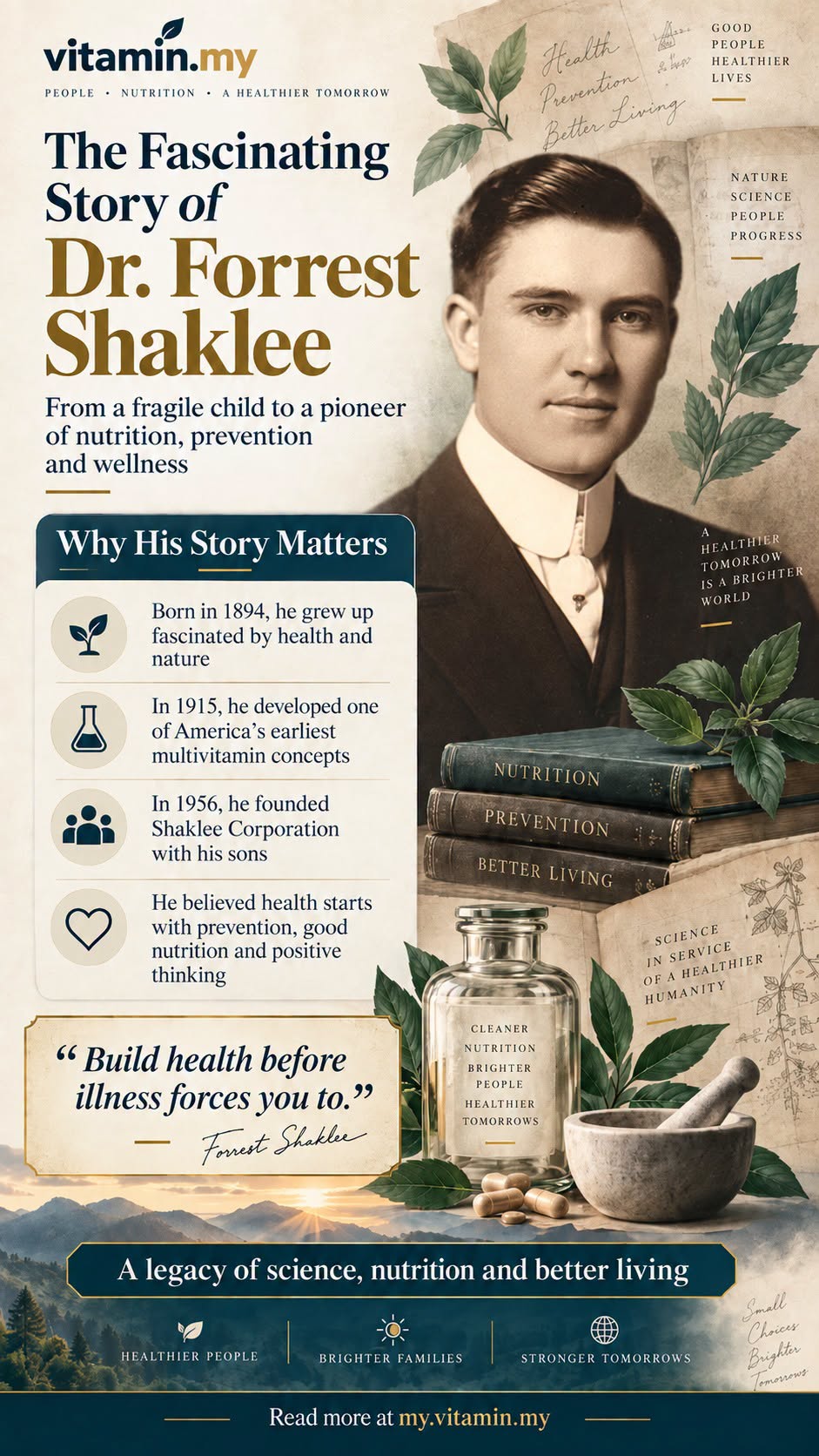
Long before the Shaklee Corporation was established in 1956, Forrest Clell Shaklee was already developing ideas about nutrition, nature, health and human potential that would eventually become the foundation of the Shaklee philosophy.
Born on November 27, 1894, in Carlisle, Iowa, Forrest C. Shaklee grew up during a period when modern nutritional science was still in its infancy. Vitamins had not yet been fully identified, nutritional deficiencies were poorly understood, antibiotics had not been developed, and many illnesses that can be treated today were far more dangerous.
Yet from these circumstances emerged a man who became fascinated by one central question:
What does the human body need in order to function at its best?
That question would follow Forrest Shaklee for decades.
It would influence his studies, his clinical work, his interest in nutrition, his philosophy of positive thinking and eventually the creation of Shaklee Corporation.
More than a century later, his ideas about prevention, nutrition, healthy living and environmental responsibility continue to sound surprisingly modern.
A Difficult Beginning
According to traditional accounts of Dr. Shaklee’s life, he was a physically frail child and was diagnosed with tuberculosis at a very young age.
Tuberculosis was a frightening disease at the end of the nineteenth century. Effective antibiotic treatment would not become available until decades later.
His family eventually moved away from the smoke and pollution associated with the coal-mining environment around Carlisle to northern Iowa.
At that time, rest, fresh air and adequate food were among the main supportive measures commonly recommended for people recovering from tuberculosis.
For a young Forrest, long periods of recovery also meant spending a great deal of time observing the world around him.
Nature became one of his earliest teachers.
Instead of simply seeing forests, animals and plants, he began wondering why living organisms behaved the way they did.
He reportedly observed that animals instinctively sought the foods and environments that supported their survival.
That observation would influence his later philosophy that human health should exist in greater harmony with nature.
It was an idea he would continue developing throughout his life.
Learning From Nature
Forrest Shaklee’s childhood experience appears to have left a deep impression on him.
Being physically weaker than other children could have created a sense of limitation.
Instead, it appears to have stimulated his curiosity.
As he grew older, he began exercising and studying the connection between food, physical vitality and health.
This was occurring during an extraordinary period in nutritional science.
At the beginning of the twentieth century, scientists were beginning to realize that humans needed much more than simply protein, fat, carbohydrates and minerals to survive.
Researchers observed that certain diseases occurred when particular components were missing from the diet.
In 1912, Polish biochemist Casimir Funk introduced the term “vitamine” to describe some of these essential dietary factors.
The science was only beginning.
The structures and functions of many individual vitamins would not be established until years later.
Against this background, Forrest Shaklee became increasingly interested in nutrition.
His fascination was therefore not occurring in isolation.
He happened to be living during one of the most important periods in the history of nutritional science.
Studying Chiropractic and Looking Beyond One System
Forrest Shaklee eventually studied at the Palmer School of Chiropractic.
Chiropractic itself was still a relatively young profession.
However, Shaklee apparently did not believe that one method alone could explain every health problem.
This became an important feature of his thinking.
He was interested not merely in treating symptoms, but in understanding the entire person—including nutrition, physical condition, lifestyle and mental attitude.
During his clinical training and early practice, Shaklee reportedly became concerned about people who appeared to consume plenty of food while still receiving inadequate nutrition.
Today we might describe a similar situation as being overfed but undernourished.
A person may consume excess calories while still having poor dietary quality.
A diet dominated by highly refined foods, for example, can provide substantial energy but relatively little fibre and limited amounts of certain micronutrients.
This concept is now widely discussed in modern nutritional science.
For Shaklee, however, the observation helped reinforce his belief that nutrition should be considered an important foundation of health.
1915: The Beginning of a Nutritional Idea
One of the most significant dates associated with Shaklee history is 1915.
Shaklee company historical material states that Dr. Forrest Shaklee developed a nutritional formulation known as Vitalized Minerals around this period.
It is described by Shaklee as one of the earliest multivitamin and mineral formulations in the United States.
The significance of the date is easy to overlook today.
Walk into a pharmacy in 2026 and shelves may contain hundreds of nutritional supplements.
Consumers can choose multivitamins, vitamin C, vitamin D, calcium, magnesium, omega-3 fatty acids, protein powders, probiotics, plant extracts and dozens of other preparations.
In 1915, the nutritional world looked completely different.
Scientists were still trying to identify the basic substances in food that were necessary for human health.
The term vitamin itself had only recently entered scientific vocabulary.
Against that background, the development of a nutritional formulation designed to supplement everyday food was a remarkably early idea.
Shaklee’s later nutritional philosophy would continue to emphasize the importance of obtaining nutrients from a good diet while using supplementation to support nutritional needs.
From Nutrition to a Broader Approach to Health
In 1917, Shaklee moved to Fort Dodge, Iowa.
Historical accounts describe him creating a health facility that brought together practitioners from different areas.
This was consistent with his broader view of health.
Rather than looking at the human body through only one lens, Shaklee believed multiple disciplines could contribute useful knowledge.
He also continued exploring the relationship between nutrition and recovery.
His interest in nutrition grew alongside his clinical experience.
However, one event in his early professional life would dramatically change his direction.
The X-Ray Incident That Changed His Life
During the early twentieth century, X-ray technology was revolutionary.
X-rays had only been discovered by Wilhelm Conrad Röntgen in 1895.
Medical practitioners quickly recognized their diagnostic potential.
Unfortunately, the danger of repeated radiation exposure was not yet completely understood.
Early X-ray operators sometimes received extremely high radiation doses compared with modern safety standards.
Historical accounts of Dr. Shaklee’s life state that he developed serious radiation-related injuries after extensive work with early X-ray equipment.
Some Shaklee biographies also describe a diagnosis of cancer and recommendations for radical treatment.
This period became a major turning point in the story traditionally told about his life.
Dr. Shaklee reportedly withdrew from his busy practice and concentrated intensely on rest, nutrition, fasting, monitoring his health and maintaining a positive mental attitude.
Later accounts state that his physical condition improved.
However, this historical story needs to be understood carefully.
It should not be interpreted as evidence that nutrition, fasting, supplements or positive thinking can cure cancer.
Cancer is a complex group of diseases requiring appropriate medical diagnosis and evidence-based treatment. Nutrition can play an important supportive role in general health, but anyone diagnosed with cancer should work with qualified oncology professionals rather than replacing treatment with supplements or alternative therapies.
What is historically important about this episode is how strongly it influenced Shaklee’s personal philosophy.
He became increasingly convinced that health should be built proactively rather than considered only after disease appeared.
From Treating Disease to Building Health
This change in emphasis became central to Forrest Shaklee’s later work.
Instead of asking only:
“How do we treat a sick person?”
he became increasingly interested in another question:
“How do we help healthy people remain healthy?”
That distinction remains highly relevant today.
Modern healthcare frequently discusses prevention.
We are encouraged to exercise before cardiovascular disease develops, control body weight before diabetes occurs, avoid smoking before lung disease appears, sleep adequately before chronic exhaustion becomes established and consume nutritious food throughout life.
In other words, modern preventive healthcare increasingly focuses on maintaining function rather than simply repairing damage.
Shaklee had been thinking along similar philosophical lines many decades earlier.
Disaster Strikes Again
In 1929, another major setback reportedly occurred when Shaklee’s clinic was destroyed by fire.
Records, equipment and years of accumulated work were lost.
For many people, this would have been enough reason to abandon everything.
Forrest Shaklee instead appears to have treated the disaster as another turning point.
A surviving book by writer and philosopher Elbert Hubbard reportedly influenced him deeply.
One idea particularly resonated with him: physical possessions can disappear, but knowledge and ideas remain.
This idea eventually became connected to another major part of Shaklee’s philosophy—something he called Thoughtsmanship.
What Was “Thoughtsmanship”?
Thoughtsmanship was Forrest Shaklee’s attempt to describe the disciplined use of thoughts and attitudes.
He believed that the way humans think influences the way they approach life.
The concept was not simply about repeating positive slogans.
It emphasized personal responsibility, constructive thinking, purpose and conscious decision-making.
Modern psychology would not necessarily use the same terminology, but certain elements sound familiar.
Today researchers study relationships between stress, behaviour, emotional wellbeing, motivation, sleep, social connection and physical health.
Positive thinking cannot magically eliminate disease.
Yet mindset can influence behaviour.
A person who believes improvement is possible may be more likely to exercise, seek help, follow treatment, change eating habits or continue working toward long-term goals.
Conversely, chronic stress and unhealthy coping behaviours can negatively affect wellbeing.
Forrest Shaklee spent years lecturing and writing about these ideas.
In the late 1940s he established the Shaklee Foundation, and by the early 1950s several volumes dealing with Thoughtsmanship had been published.
It demonstrates something important about him.
He was not interested only in tablets and minerals.
His concept of wellness included body, behaviour, environment and mind.
Nature and Science—Not Nature Versus Science
One of the easiest ways to misunderstand Dr. Shaklee’s philosophy is to assume that believing in nature meant rejecting science.
His career suggests almost the opposite.
He maintained a strong fascination with scientific research.
Forrest Shaklee’s approach was based on observing nature and then attempting to understand it.
That distinction remains useful today.
Something is not automatically safe simply because it is natural.
Many poisonous substances are natural.
Likewise, something is not automatically harmful simply because it has been created through modern technology.
The important questions are:
What does the scientific evidence show?
What dose is being used?
Is it safe?
Does it work?
How is it manufactured?
What is its effect on the human body and the environment?
This combination of nature and science eventually became deeply embedded in the Shaklee identity.
Starting a Company at an Age When Many People Retire
Perhaps one of the most fascinating parts of Forrest Shaklee’s story is when he actually established the company bearing his name.
He did not create Shaklee Corporation as a young entrepreneur in his twenties.
The company was established in 1956, when Dr. Shaklee was already in his early sixties.
He worked with his sons, Forrest Jr. and Lee Shaklee.
Think about that for a moment.
Many people spend their lives believing that major achievements must happen while they are young.
By conventional standards, Dr. Shaklee could easily have considered his most productive years behind him.
Instead, he began another enormous chapter of his life.
The philosophy was relatively straightforward.
Produce nutritional and household products built around principles the family believed in, then teach people about those products through personal relationships.
A statement attributed to Dr. Shaklee summarised the educational approach:
Teach people, and those people can teach others.
That became the basis of a direct-selling system.
Instead of depending exclusively on conventional retail shelves and mass advertising, customers learned about products through individual distributors.
Why Education Was Necessary
The nutritional supplement market of 1956 was nothing like today’s market.
Today consumers actively search Google, TikTok, YouTube and social media for information about protein, vitamins, gut health, healthy ageing, antioxidants and nutrition.
In 1956, many consumers had little reason to think about nutritional supplementation.
Therefore Shaklee distributors could not simply offer a product.
They first had to explain why nutrition mattered.
The business model consequently depended heavily on education.
That principle remains relevant.
Health products should never be marketed merely through exaggerated promises.
Consumers deserve to understand what a nutrient does, how much they need, where it can be obtained from food, what evidence supports supplementation and where its limitations lie.
Good health education should create informed consumers rather than fearful consumers.
A Philosophy That Extended Beyond Nutrition
Another interesting part of the Shaklee story is that concern for health gradually expanded to concern for the environment.
If human wellbeing depends partly on clean air, clean water and a healthy environment, then personal health and environmental health cannot be completely separated.
Shaklee introduced Basic-H in the 1960s, described by the company as one of the early non-toxic biodegradable concentrated cleaners.
Later household products placed additional emphasis on biodegradability and reduced environmental impact.
Decades later, Shaklee’s environmental initiatives expanded substantially.
The company reports that it became the first company certified Climate Neutral in 2000 and has continued initiatives involving renewable energy, emissions offsets, tree planting and more sustainable packaging.
Whether someone is interested in supplements or not, the broader principle is worth considering:
Health does not stop at the edge of our skin.
The condition of the planet eventually influences human health.
Air pollution, contaminated water, climate change, food systems and exposure to harmful substances can all affect wellbeing.
More Than a Century After Vitalized Minerals
From the formulation associated with 1915 to the Shaklee Corporation founded in 1956, the company continued developing nutritional products during the decades that followed.
Its historical product milestones have included multivitamins, protein products, vitamin C formulations, omega-3 supplements and later generations of nutritional products.
Shaklee’s Malaysian product guide describes the company’s history as more than a century of nutrition-related innovation beginning with Dr. Shaklee’s early work.
But the most important legacy may not be any single product.
The larger legacy is the collection of principles behind them:
Nutrition matters.
Prevention matters.
Science matters.
Nature matters.
Quality matters.
The environment matters.
And individual choices matter.
What Dr. Shaklee’s Story Can Teach Us in 2026
The world Dr. Forrest Shaklee was born into in 1894 bears almost no resemblance to the world of 2026.
Yet some of the problems are strangely familiar.
We have unprecedented access to food, yet poor nutritional quality remains common.
We have extraordinary medical technology, yet chronic lifestyle-related diseases continue to affect millions.
We have smartphones capable of accessing almost the entire world’s knowledge, yet misinformation about health spreads faster than ever.
We have enormous convenience, yet many people move less, sleep poorly and live under chronic stress.
This makes several lessons from Shaklee’s life surprisingly relevant.
1. Health Is Built Daily
Health is rarely determined by one meal, one supplement or one workout.
It is shaped by thousands of repeated decisions.
What do we eat most days?
Do we move?
Do we sleep adequately?
Do we smoke?
How much alcohol do we consume?
Do we attend health screenings?
Do we follow prescribed medical treatment?
How do we manage stress?
These apparently small choices accumulate over decades.
2. Food Comes First
Supplements should complement a healthy diet—not become an excuse for an unhealthy one.
Vegetables, fruits, legumes, whole grains, adequate protein, healthy fats and minimally processed foods should form the foundation of good nutrition.
Supplements may help fill specific nutritional gaps in appropriate circumstances, but they cannot reproduce every benefit of a balanced diet.
3. Be Curious, But Remain Scientific
Dr. Shaklee lived during a period of enormous scientific discovery.
That curiosity is worth preserving.
However, modern consumers have an additional responsibility: distinguish evidence from marketing.
A health claim should be evaluated according to clinical evidence, appropriate dosage, safety and context.
The stronger the claim, the stronger the evidence should be.
4. Prevention Is Powerful
Many chronic diseases develop gradually.
Maintaining healthy blood pressure, cholesterol, blood glucose, body weight and physical activity over decades can be far more valuable than waiting until serious disease develops.
Preventive health may feel boring because its benefits are often invisible.
But that is precisely the point.
Sometimes the greatest health victory is the disease that never happens.
5. Age Does Not End Your Ability to Create
Dr. Shaklee founded his company in his early sixties.
That alone makes his story remarkable.
Society often treats ageing as a period of decline.
His experience offers another perspective.
Experience can accumulate.
Knowledge can accumulate.
Networks can expand.
Ideas can mature.
Starting something new at 50, 60 or even 70 is not necessarily too late.
Sometimes everything learned during the first half of life becomes the preparation for the next chapter.
Better Health, Better World
The philosophy surrounding Shaklee eventually evolved into the broader idea that improving ourselves can contribute to improving the world around us.
Personal health affects families.
Healthy families affect communities.
Responsible businesses influence industries.
Environmental decisions made by companies influence ecosystems.
One person’s actions may appear small, but collective behaviour can become enormous.
That may explain why Forrest Shaklee’s story remains interesting more than a century after his early experiments with nutrition.
It is not simply the story of a supplement company.
It is the story of a man whose life repeatedly changed direction.
A sick childhood led to curiosity about health.
Clinical practice led to questions about nutrition.
Physical injury led to a stronger focus on lifestyle and wellbeing.
A devastating fire led to deeper thinking about knowledge and mindset.
Decades of research eventually led him—at an age when many people begin thinking about retirement—to establish a company.
The Legacy of Dr. Forrest C. Shaklee
Dr. Forrest Clell Shaklee died in December 1985 at the age of 91.
By then, the small company he had founded with his sons had grown far beyond its beginnings.
But perhaps the most enduring part of his legacy is not measured by company size.
It can be found in an idea.
Take responsibility for your health before illness forces you to think about it.
Eat well.
Move your body.
Respect nature.
Continue learning.
Use science.
Think constructively.
Take care of the environment that supports human life.
And understand that health is not created overnight.
It is built, choice by choice, throughout a lifetime.
That philosophy was radical enough to inspire Forrest Shaklee more than a hundred years ago.
In an age of ultra-processed food, sedentary lifestyles, environmental pressure, information overload and rapidly increasing rates of chronic disease, perhaps it is even more relevant today.
Final Thoughts
The fascinating story of Dr. Forrest Shaklee is ultimately a story about curiosity and persistence.
He grew up physically frail.
He entered a health profession while nutritional science was still developing.
He experienced professional and personal setbacks.
He continued studying.
He continued writing.
He continued questioning accepted ideas.
And at an age when many people would have chosen to slow down, he helped create a company whose history would stretch across generations.
We do not need to accept every historical claim uncritically to appreciate the larger lesson of his life.
Scientific knowledge evolves.
Medical practices change.
Nutritional recommendations become more precise as new evidence appears.
That is exactly why curiosity should never end.
Perhaps the most appropriate way to honour the legacy of pioneers such as Forrest Shaklee is not simply to repeat what they believed.
It is to continue asking questions.
To continue testing ideas.
To continue improving.
And to continue looking for ways to create healthier lives while leaving a healthier planet for the generations that follow.
That is a story that began long before Shaklee Corporation opened its doors in 1956.
And more than a century after Forrest Shaklee began exploring the relationship between nutrition and health, the conversation continues.
Medical note: Nutritional supplements are intended to complement, not replace, a balanced diet or appropriate medical care. Historical accounts concerning Dr. Shaklee’s illnesses are biographical narratives and should not be interpreted as evidence that diet, fasting or supplements can cure cancer, tuberculosis or other serious diseases. Anyone with a medical condition should obtain appropriate professional diagnosis and treatment.
