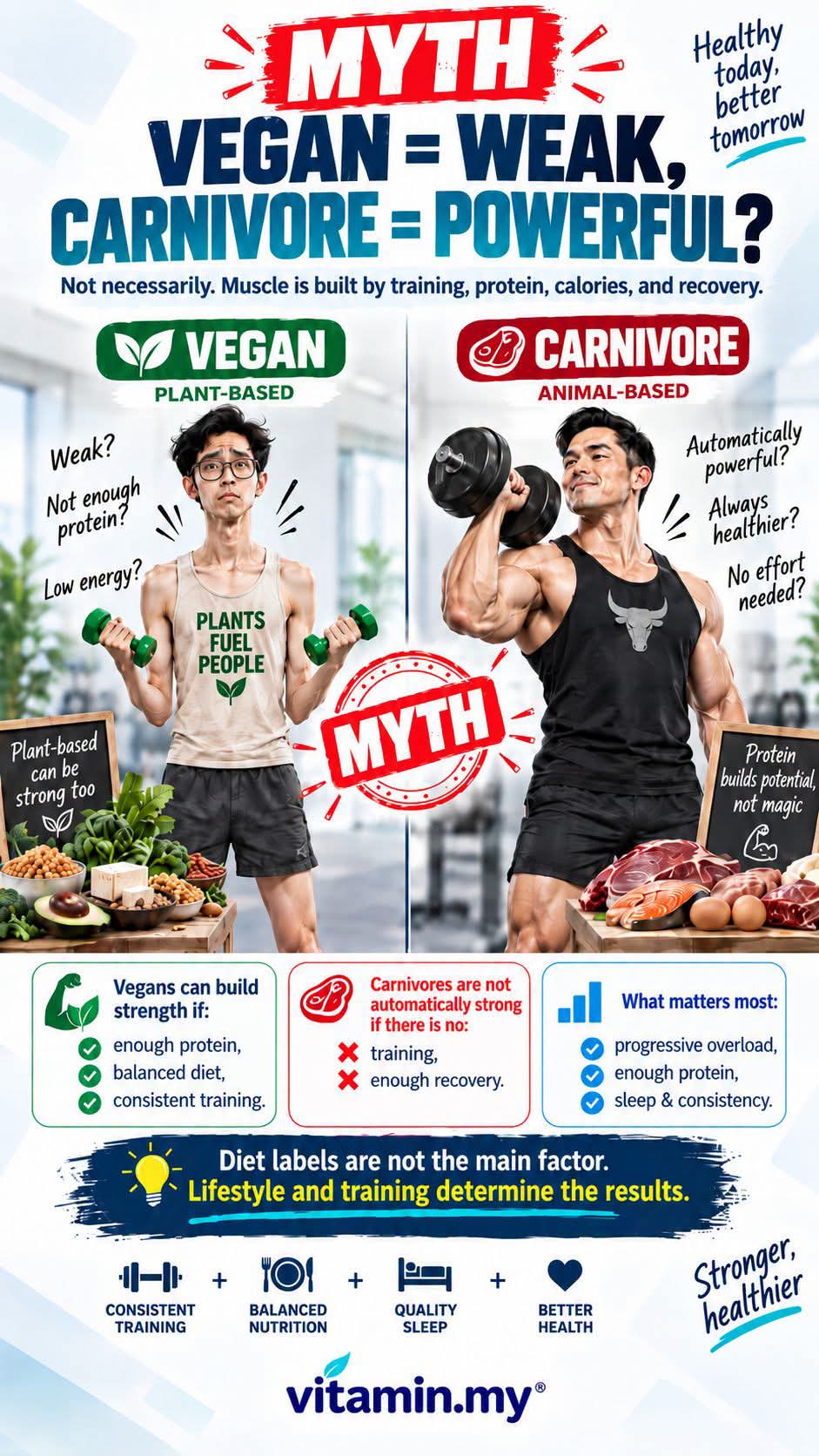
Put a skinny vegan beside a muscular meat eater and the message seems obvious.
Vegan = weak. Carnivore = powerful.
It makes a great meme. It is also a very poor explanation of human physiology.
The debate over vegan vs carnivore muscle strength has become increasingly popular on social media. On one side, vegan advocates point to plant-based athletes who run ultramarathons, lift impressive weights and build muscular physiques. On the other, carnivore advocates argue that humans need meat, animal protein and creatine to achieve maximum strength.
So who is right?
The science gives a much more interesting answer.
A person’s ability to build and maintain muscle depends heavily on resistance training, total protein intake, energy intake, protein quality, recovery, sleep, genetics and consistency. Whether the protein originates from tofu or steak matters to some degree, but the difference is far smaller than the internet often makes it appear.
In other words, your muscles cannot read the label on your diet.
They respond to what you actually do with them.
Why Do People Think Vegans Are Weak?
The stereotype did not appear from nowhere.
Animal foods such as meat, fish, eggs and dairy are concentrated sources of high-quality protein. They generally contain all essential amino acids in favourable proportions and are often rich in leucine, one of the amino acids involved in stimulating muscle protein synthesis.
Animal foods also naturally provide nutrients associated with muscle function and performance, including vitamin B12, iron, zinc and creatine.
Plant foods are different.
Many individual plant foods contain less protein per serving. Some plant proteins have lower digestibility or lower concentrations of certain essential amino acids compared with animal proteins.
Therefore, someone who simply removes meat, eggs and dairy without replacing their protein and nutrient intake intelligently could end up eating too little protein or too few calories.
That person may indeed lose weight, muscle and strength.
But that is not evidence that veganism automatically makes people weak.
It is evidence that poorly planned diets can be poorly planned.
The Academy of Nutrition and Dietetics has stated that appropriately planned vegetarian and vegan dietary patterns can be nutritionally adequate for adults.
The important words are appropriately planned.
Can Vegans Really Become Muscular and Strong?
Yes.
You do not have to eat meat for resistance training to stimulate muscle growth.
When muscle fibres experience sufficient mechanical tension during resistance exercise, the body initiates signalling processes involved in repair and adaptation. Dietary amino acids then provide building materials for new muscle proteins.
That mechanism exists whether those amino acids originally came from beef, milk, soybeans, peas or another protein source.
Recent systematic reviews examining athletes and plant-based dietary patterns have generally not found evidence that well-planned plant-based diets inherently reduce strength, power or athletic performance.
This does not mean every plant protein is nutritionally identical to every animal protein.
It means the simple claim that “plants cannot build strong muscles” is unsupported.
Plant Protein vs Animal Protein: Are They Exactly Equal?
This is where the discussion needs more nuance.
The latest evidence suggests animal protein can have some advantages under certain conditions.
Some systematic reviews and meta-analyses have found a small advantage for animal protein in certain measures of lean mass or muscle mass. However, differences in muscle strength and physical performance are often much smaller or statistically insignificant.
Soy protein deserves particular attention because studies frequently show that it can support muscle development effectively when total protein intake is adequate.
Research examining muscle protein synthesis also suggests that animal protein may sometimes produce a slightly stronger acute anabolic response, particularly in older adults.
But younger adults consuming adequate amounts of high-quality plant protein can still achieve a strong muscle-building response.
So the scientifically accurate message is not:
Plant protein is identical to animal protein.
Neither is it:
Plant protein cannot build muscle.
A better conclusion is that protein source can influence protein quality and the anabolic response, but total protein intake, food selection and resistance training can greatly reduce the practical difference.
Protein Quality: Why Leucine Matters
Protein is made from amino acids.
Nine amino acids are considered essential because the body cannot manufacture enough of them on its own.
Among them, leucine receives particular attention in sports nutrition because it helps activate signalling involved in muscle protein synthesis.
Many animal proteins naturally provide relatively high concentrations of leucine and essential amino acids.
Some plant proteins contain less leucine per gram or are digested less efficiently.
This can be compensated for in several ways.
- Consume a sufficient total amount of protein
- Choose higher-quality plant proteins
- Eat a variety of protein sources
- Distribute protein across several meals
- Use larger servings when necessary
Soy is particularly useful because it provides a relatively complete amino-acid profile. Pea, potato and blended plant proteins can also contribute effectively.
The important word once again is planning.
How Much Protein Do You Actually Need?
The answer depends on body size, activity level, age, goals and overall energy intake.
For people performing regular resistance training, a useful evidence-based target is approximately 1.4 to 2.0 grams of protein per kilogram of body weight per day.
Research on resistance training suggests that muscle-building benefits often begin to level off at around 1.6 g/kg/day for many people, although individual needs can vary.
Take a 70 kg person.
At 1.6 g/kg, that equals approximately 112 grams of protein per day.
A person does not have to hit that number perfectly every single day, and eating more protein does not automatically mean more muscle.
But it provides some perspective.
Eating one salad with a few chickpeas and saying, “I eat plant-based,” is very different from intentionally constructing a diet that delivers enough protein.
The same applies to meat eaters.
One steak does not cancel an otherwise poor diet.
The Biggest Muscle-Building Factor Is Not Meat or Plants
Suppose two men weigh approximately the same.
The first follows a vegan diet. He eats sufficient protein and calories, trains three or four times each week, progressively increases his workload and sleeps seven to eight hours most nights.
The second follows a carnivore diet. He eats plenty of meat but rarely trains, sleeps poorly and spends most of the day sitting.
Who will probably develop more muscle?
The vegan.
Why?
Because muscle requires a reason to remain muscle.
Resistance exercise supplies that reason.
This is the principle behind progressive overload.
If you gradually challenge a muscle with more resistance, repetitions, training volume or increasingly difficult exercises, the muscle has to adapt.
Protein supports that adaptation.
It does not replace the training stimulus.
Think about building a house.
Protein is the bricks, cement and steel.
Training is the construction crew.
You can deliver truckloads of building materials to an empty field, but no house appears unless someone actually starts building.
Does the Carnivore Diet Automatically Make You Powerful?
No.
A carnivore diet can certainly provide large amounts of protein.
Meat, eggs, fish and dairy can provide highly digestible protein with substantial amounts of essential amino acids.
But that does not mean a carnivore diet itself produces strength.
An inactive person consuming 180 grams of animal protein every day does not automatically become stronger than someone eating 120 grams of plant protein while following an effective resistance-training programme.
Muscle adaptation is training-dependent.
This distinction becomes especially important because social media often uses muscular carnivore influencers as proof that carnivore eating caused their physiques.
But we rarely see the complete history.
That individual may have trained for ten years.
They may have developed most of their muscle before starting a carnivore diet.
Their genetics, previous calorie intake, supplements, training volume, sleep and sometimes performance-enhancing drugs may also contribute.
A photograph cannot establish causation.
What Does Science Actually Say About the Carnivore Diet?
This is an area where online certainty currently exceeds scientific certainty.
Carnivore diets typically eliminate virtually all plant foods and rely predominantly or exclusively on meat, fish, eggs and sometimes dairy.
Long-term controlled research is still extremely limited.
Available studies have reported some potentially favourable effects such as weight loss, satiety and improvements in selected metabolic markers in some participants.
However, researchers have also raised concerns about low fibre intake, possible micronutrient inadequacies and increased LDL cholesterol in some individuals.
Therefore, saying “carnivore is dangerous for everyone” goes beyond the evidence.
But saying “carnivore is scientifically proven to be the healthiest human diet” also goes far beyond the evidence.
At present, strong long-term evidence simply does not exist.
What About Carbohydrates?
Another common fitness argument claims that carbohydrates are unnecessary because meat provides everything required for strength.
The body can certainly function with very low carbohydrate intake.
But “the body can function without much carbohydrate” is not the same statement as “carbohydrate is useless for training.”
Muscle glycogen is an important fuel source during repeated high-intensity exercise.
People performing bodybuilding sessions, repeated sets, CrossFit-style training, sprinting or high-volume sports may benefit from having sufficient carbohydrate available.
Plant-based diets often naturally contain more carbohydrate from foods such as rice, oats, potatoes, fruit, legumes and grains.
A carnivore or very-low-carbohydrate athlete may adapt to lower carbohydrate intake, but adaptation does not prove that carbohydrates impair performance.
Once again, context matters.
The best diet for a sedentary person trying to control appetite may not be identical to the best diet for somebody performing high-volume strength training six days per week.
The Interesting Case of Creatine
Carnivore advocates do have one legitimate nutritional point: animal foods naturally contain creatine.
Creatine is stored largely in skeletal muscle as creatine and phosphocreatine and plays an important role in rapid energy production.
People eating little or no meat often have lower dietary creatine intake and may have lower baseline muscle creatine stores.
This is where creatine supplementation becomes interesting.
Studies show that vegetarians and vegans can increase muscle creatine stores with creatine supplementation, and some research suggests that they may experience meaningful improvements in certain measures of muscular performance and lean tissue.
Therefore:
Vegans may consume less creatine naturally.
But that does not mean:
Vegans cannot become powerful.
It simply identifies one nutritional difference that can be addressed.
Nutrients Vegans Need to Watch Carefully
Being vegan does not automatically mean being healthy.
French fries, sugary drinks and highly processed snacks can technically be vegan.
For a vegan diet to support health and athletic performance, food quality and nutrient adequacy matter.
Protein deserves attention, but so do:
- Vitamin B12
- Iron
- Calcium
- Zinc
- Iodine
- Vitamin D
- Omega-3 fats
Vitamin B12 deserves special emphasis.
Natural vitamin B12 is primarily found in animal-derived foods, while plant foods generally provide meaningful amounts only when fortified.
People eating little or no animal food therefore need a reliable source of vitamin B12 from fortified foods or supplementation.
Iron is another consideration because plant-derived non-heme iron is absorbed differently from heme iron found in animal foods.
This does not mean deficiency is inevitable.
It means intake and food selection deserve attention, particularly in people with higher nutritional requirements.
The same principle applies to every restrictive diet: the more categories of food you remove, the more carefully you should examine what nutrients disappeared with them.
Nutrients Carnivore Dieters Should Not Ignore Either
Carnivore supporters often focus on nutrients abundant in meat, including protein, vitamin B12, iron, zinc and selenium.
Those are genuine nutritional strengths.
However, eliminating plant foods also removes other nutritional components.
Depending on the exact foods eaten, a strict carnivore pattern may provide little dietary fibre and can make it more challenging to obtain nutrients such as magnesium, vitamin C, folate and potassium.
Actual nutrient intake varies considerably depending on whether someone eats seafood, dairy, eggs, organ meats or only muscle meat.
This is important because “animal-based” is not one single diet.
Someone eating salmon, sardines, eggs, yoghurt and lean meat is following a very different nutritional pattern from someone eating butter and fatty beef almost exclusively.
Just as a thoughtful vegan diet should not be judged by someone living on chips and biscuits, an animal-heavy diet should not be evaluated from a single steak photograph.
Muscle Strength and Health Are Not Exactly the Same Thing
This is another mistake that frequently appears in social-media debates.
A diet might support muscle gain while still raising questions about long-term health.
Likewise, a diet associated with favourable cardiovascular markers does not automatically maximize bodybuilding performance.
Being muscular is not proof that every aspect of someone’s diet is healthy.
Current cardiovascular and public-health dietary guidance continues to emphasize overall dietary patterns rich in minimally processed foods, vegetables, fruits, whole grains, legumes, nuts, appropriate protein sources and unsaturated fats.
So the question should not merely be:
“Can this diet build muscle?”
We should also ask:
“Can I sustain it, meet my nutritional requirements, maintain healthy biomarkers and support long-term health?”
Those are not always the same question.
What If Your Goal Is to Stay Strong After 40?
This may be more important than the vegan-versus-carnivore argument itself.
As people age, maintaining muscle becomes increasingly valuable.
The goal should not always be to make the number on the weighing scale as small as possible.
Aggressive dieting without resistance training can result in losing lean mass along with fat.
That is why middle-aged and older adults should think beyond weight loss.
Think about muscle retention.
Resistance training, adequate protein, sufficient energy and recovery become increasingly important.
Older adults may also need to pay additional attention to protein quantity and quality because ageing muscle can become less responsive to smaller protein doses.
A 50-year-old vegan therefore should not simply copy the diet of a 20-year-old vegan influencer.
Neither should a 50-year-old meat eater assume eating more steak removes the need to train.
The fundamental principle remains the same:
Use the muscle if you want the body to keep it.
So Which Diet Wins: Vegan or Carnivore?
Neither wins automatically.
A carefully planned vegan diet can support strong, muscular and athletic people.
An omnivorous or animal-heavy diet can also support muscle growth extremely well.
Animal proteins may offer practical advantages in digestibility, essential amino-acid density, leucine content and certain micronutrients.
Research suggests there may be a modest advantage for some animal proteins for certain muscle-mass outcomes under specific conditions.
However, differences in actual strength are often much less dramatic than social media claims suggest.
Meanwhile, appropriately planned plant-based diets have not been shown to inherently prevent strength or athletic development.
Therefore, the strongest conclusion is not ideological.
It is practical.
- Training quality matters.
- Protein quantity matters.
- Protein quality matters.
- Energy intake matters.
- Sleep matters.
- Recovery matters.
- Consistency matters.
The label on the diet comes after those fundamentals.
Frequently Asked Questions About Vegan vs Carnivore Muscle Strength
Can a vegan become as strong as a meat eater?
Yes. A vegan can develop substantial strength when energy intake, protein intake, resistance training and recovery are adequate. Protein source can influence protein quality, but current evidence does not support the claim that vegan diets inherently prevent strength development.
Is animal protein better for building muscle?
Some animal proteins have advantages in digestibility, leucine content and essential amino-acid composition. Research suggests there may be a small advantage for certain muscle-mass outcomes, but differences in strength are much smaller. Well-planned plant protein intake can still support substantial muscle growth.
How can vegans get enough protein?
Useful sources include soy foods, tofu, tempeh, lentils, beans, chickpeas, peas, seitan, nuts, seeds and appropriately formulated plant-protein powders. Total daily intake and dietary variety matter more than finding one magical protein food.
Do carnivores build muscle faster?
Not automatically. An animal-based diet may make it easier to consume large quantities of highly digestible protein, but resistance training remains the primary stimulus for muscle adaptation.
Do vegans need supplements?
Vitamin B12 requires particular attention because reliable natural plant sources are limited. Depending on the person’s diet, environment, blood tests and individual requirements, nutrients such as vitamin D, iodine, omega-3 or iron may also need attention. Supplement decisions should be individualized rather than based solely on diet labels.
Final Verdict: Your Muscles Do Not Care About Your Tribe
The internet loves teams.
Vegan versus carnivore.
Plants versus meat.
Carbohydrates versus fat.
Unfortunately, human physiology refuses to behave like a social-media argument.
You can eat meat and still be weak.
You can eat plants and become extremely strong.
You can consume huge amounts of protein and still fail to build meaningful muscle if you never challenge your muscles.
And you can train extremely hard yet limit your progress if you chronically under-eat, sleep badly or fail to consume enough protein.
So the next time someone posts a picture of a skinny vegan beside a muscular carnivore, remember:
That picture proves almost nothing.
The muscular person may have trained for a decade.
The skinny person may never have lifted weights.
Their calories, protein intake, sleep, genetics, training history and lifestyle may be completely different.
The real question is not simply vegan vs carnivore muscle strength.
The better question is:
Are you giving your muscles enough reason, enough nutrition and enough recovery to become stronger?
Because ultimately:
Vegan does not automatically mean weak.
Carnivore does not automatically mean powerful.
And your diet label does not lift the weight.
You do.
Health note: This article is for general educational purposes and is not individualized medical or dietetic advice. People with kidney disease, metabolic conditions, pregnancy, nutrient deficiencies or other medical concerns should discuss major dietary changes or high-protein diets with an appropriate healthcare professional.
