Searching for a Shaklee iron supplement usually starts with a practical concern: feeling exhausted, hearing that your hemoglobin is low, or wanting better nutritional support during a demanding stage of life.
However, choosing iron requires more than comparing testimonials. The useful questions are how much iron the product provides, whether you need additional iron, and whether you are supporting everyday nutrition or treating a confirmed deficiency.
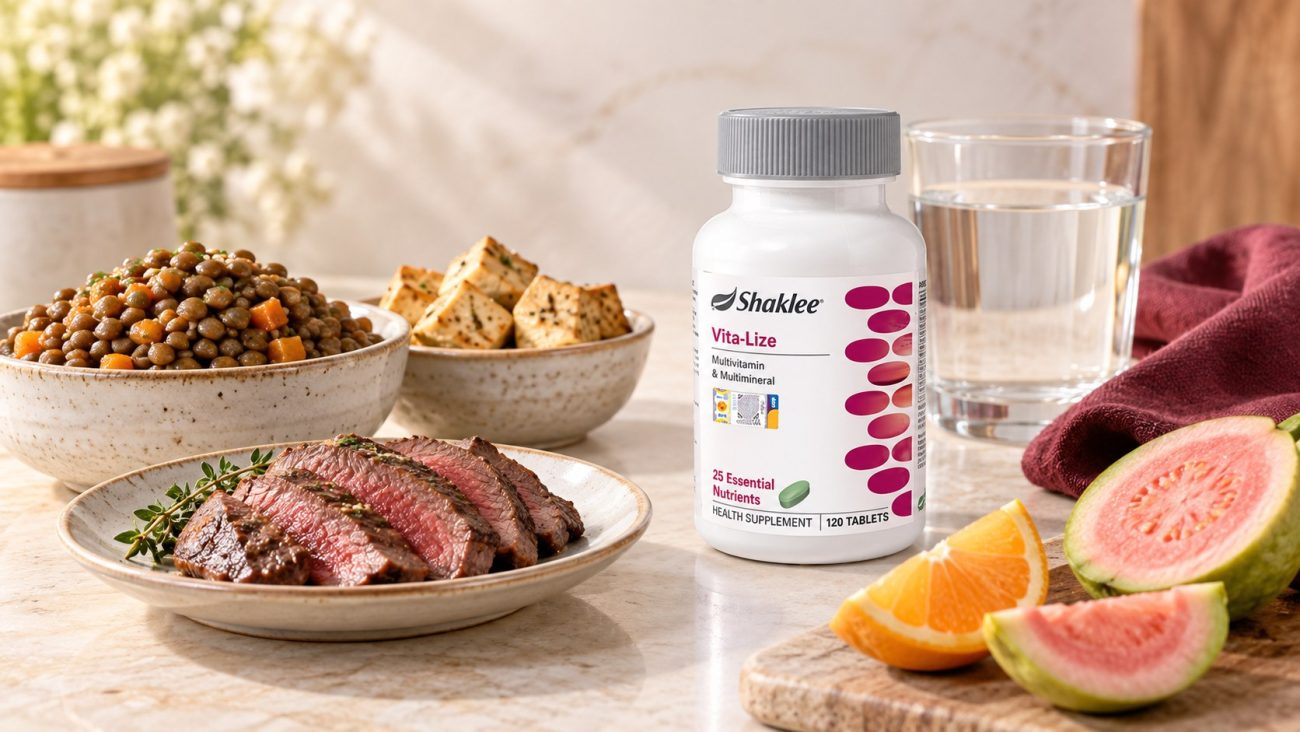
There is also an update for Malaysian readers. Older articles discuss Vita-Lea with iron, while Shaklee Malaysia currently lists Vita-Lize, a multivitamin and mineral supplement containing iron. Products sold in different countries can have different formulas.
This guide explains the Malaysian product, recent research through September 2026, practical food choices, side effects and publicly available customer experiences. It will help you approach the subject with realistic expectations and better questions for your healthcare professional.
Disclosure: vitamin.my is an independent Shaklee distributor website. This article provides general education; individual treatment decisions require advice from a qualified healthcare professional.
.png)
What is the Shaklee iron supplement available in Malaysia?
The official Malaysian Vita-Lize page describes an adult multivitamin containing 25 vitamins and minerals. Its directions specify two tablets once daily with a meal.
The ingredient table lists quantities per tablet. Selected amounts are shown below; the serving values are calculated by doubling them.
| Nutrient | One tablet | Two-tablet serving |
|---|---|---|
| Iron, as ferrous fumarate | 9 mg | 18 mg |
| Folate, as folic acid | 300 mcg | 600 mcg |
| Vitamin B12 | 3 mcg | 6 mcg |
| Vitamin C | 60 mg | 120 mg |
| Iodine | 75 mcg | 150 mcg |
These figures update older descriptions that mentioned different folic acid and iodine amounts. Always compare the current Malaysian bottle with the local product information. Source: Shaklee Malaysia Vita-Lize.
Vita-Lea Women sold in the United States is a separate market formula. Its official page lists 18 mg iron, 600 mcg folic acid and 290 mcg iodine per serving. This illustrates why an overseas review cannot establish the contents of a Malaysian product. Source: Shaklee US Vita-Lea Women.
Vita-Lize combines several nutrients in one routine. Whether its iron amount suits you depends on your diet, blood results and clinical circumstances.
.png)
Why iron matters for energy and everyday function
Iron helps the body make hemoglobin, the protein that carries oxygen in red blood cells. It also contributes to myoglobin, which supports oxygen availability in muscles.
Think of this as maintaining the body’s oxygen delivery system. Adding iron is useful when supply is inadequate. It does not create unlimited energy simply because more tablets are available.
Iron deficiency anemia can cause tiredness, breathlessness, headaches, palpitations and paler skin. Some people develop unusual cravings for ice or other nonfood items. Hair shedding can occur, although it has many possible causes. Source: NHS iron deficiency anemia.
These symptoms deserve attention when they persist. They cannot tell you, by themselves, that iron is the missing ingredient.
A person who sleeps poorly, eats too little or has another medical condition may also feel drained. Buying a supplement before understanding the problem can delay a more useful solution.
Check hemoglobin and iron stores before treating fatigue
Hemoglobin and iron stores describe related but different things. Your hemoglobin may still be within range while stored iron is becoming depleted.
A full blood count helps identify anemia. Ferritin helps assess stored iron, while other measurements, including transferrin saturation, can clarify the picture. Ferritin can rise during inflammation, so a seemingly reassuring result sometimes needs further interpretation. Source: NIH iron fact sheet for health professionals.
Ask your clinician what the results mean together. A useful conversation includes symptoms, menstrual bleeding, food intake, blood donation, digestive problems and medicines.
If deficiency is confirmed, identifying its cause matters. Possible explanations include blood loss, insufficient intake or difficulty absorbing iron. Replacing iron without addressing ongoing losses may leave the underlying problem unresolved. Source: NHLBI iron deficiency anemia.
In Malaysia, thalassemia trait is another relevant consideration. A carrier may have small red blood cells and mild anemia without iron deficiency. Iron should only be used for a demonstrated need; it does not correct the inherited trait. Source: NHS thalassemia carriers.
How much iron do adults need?
For context, US dietary reference intakes vary by age and life stage:
| Group | Recommended daily iron intake |
|---|---|
| Adult men | 8 mg |
| Women aged 19–50 | 18 mg |
| Adults aged 51 and older | 8 mg |
| Pregnant adults | 27 mg |
| Breastfeeding adults | 9 mg |
These are dietary reference values for generally healthy people, covering intake from food and supplements together. They are not prescribed treatment doses or Malaysian clinical recommendations. Source: NIH iron information for consumers.
The distinction matters when comparing an 18 mg multivitamin serving with a prescription. Treating established deficiency may require a different elemental iron amount and follow-up plan.
Do not multiply multivitamin tablets to copy a medical iron dose. You would also multiply every other vitamin and mineral in the formula.
.png)
What benefits can you reasonably expect?
A Shaklee iron supplement may contribute to meeting iron needs when your existing intake falls short. A multivitamin also provides other nutrients, which may be convenient when a broader dietary gap has been identified.
For someone with confirmed iron deficiency, appropriate replacement can support recovery. However, whether this particular product supplies enough iron for treatment is a separate clinical question.
Set expectations around measurable outcomes. These might include following the agreed routine, tolerating the supplement, improving food choices and reviewing blood results at the planned appointment.
Feeling better is valuable, but it does not identify which ingredient caused the improvement. Likewise, feeling no immediate change does not prove that a nutrient was unnecessary or poorly absorbed.
Ask what success should look like for your situation. A daily nutritional supplement and a medically supervised anemia treatment can have different goals, even when both contain iron.
How to read claims about clinical studies
Shaklee’s US Vita-Lea page refers to seven clinical studies and research involving people who used multiple supplements. Those statements need to be read alongside the study population, the products used and the outcomes measured. Source: Vita-Lea research information.
For example, evidence that nutrients enter the bloodstream answers an absorption question. It does not automatically answer whether a product corrects anemia faster than another treatment.
Similarly, comparing long-term supplement users with nonusers can identify associations, but other differences between those groups may influence the results. People may also differ in diet, healthcare access and daily habits.
When reading a claim, look for the exact outcome. A nutrient level, a symptom score and a diagnosed disease are different endpoints. Strong product decisions begin with knowing which question the evidence actually addresses.
.png)
Latest research: should iron be taken daily or every other day?
Recent research has examined whether spacing therapeutic iron doses improves absorption or tolerability. This question concerns the whole regimen: formulation, elemental iron amount, frequency and duration.
A trial published in a 2025 journal issue
Dhanush and colleagues studied 68 women with iron deficiency anemia. Participants received either 60 mg elemental iron daily or 120 mg on alternate days.
At day 28, the average hemoglobin increase was greater in the alternate-day group: 2.2 versus 1.3 g/dL. Adverse effects were reported by 9% of that group and 45% of the daily group. The difference in hemoglobin improvement at day 56 was not statistically significant.
This was a small, open-label trial. It appeared online in June 2024 and in the journal’s April 2025 issue. Its findings support further investigation, rather than a universal dosing rule. Read the randomized trial.
A July 2026 study adds a different perspective
Ramos Peñafiel and colleagues followed 171 women receiving prescribed daily or alternate-day iron in routine practice. Both groups improved, with no statistically significant difference in hemoglobin at six weeks or three months.
This was an observational study, so doctors chose the schedules. It was not designed to prove the regimens equivalent. The alternate-day group also received less cumulative oral iron, and escalation to intravenous iron occurred more often, requiring cautious interpretation.
The practical message is that blood loss, treatment exposure and follow-up matter alongside the schedule. Read the 2026 study.
What this means for a Shaklee iron supplement
The American Gastroenterological Association’s 2024 expert guidance advises oral iron no more than once daily and recognizes that alternate-day treatment may suit some patients. Source: AGA expert review.
However, these studies did not test Malaysian Vita-Lize as an anemia treatment. Do not change its label directions or a prescribed regimen simply because alternate-day dosing sounds appealing.
Does everyone need extra vitamin C with iron?
Vitamin C can improve absorption of nonheme iron, including the form found in plant foods. That makes pairing meals with fruit or vegetables a useful dietary habit.
The question of adding a separate vitamin C tablet to medical iron treatment is more nuanced.
In a randomized trial involving 440 adults with iron deficiency anemia, iron alone and iron plus vitamin C produced equivalent hemoglobin recovery under the study conditions. Ferritin improvement and adverse effects were also similar. The study was published in 2020; it remains relevant evidence, rather than a new 2026 discovery. Source: Li and colleagues, JAMA Network Open.
This does not make vitamin C unimportant. It shows why a plausible absorption benefit does not automatically mean every person needs an additional supplement. Vita-Lize already contains vitamin C, so review the whole formula before adding another product.
How to take iron while keeping the routine manageable
Follow the instructions for the product actually in your hand. Vita-Lize’s Malaysian directions specify taking the adult serving with a meal. Dedicated iron medicines may have different instructions.
For example, NHS guidance says ferrous sulfate is best absorbed on an empty stomach, although food can help when it causes stomach upset. It also advises a two-hour gap before tea, coffee, dairy products or eggs. Source: NHS instructions for ferrous sulfate.
Ask a pharmacist how to apply timing advice to your particular multivitamin or prescription. A complicated timetable that you repeatedly abandon is unlikely to be useful.
Also mention other medicines and supplements. Iron can interfere with medicines such as levothyroxine and certain antibiotics. Antacids and additional mineral supplements may require timing adjustments. The appropriate gap depends on the medicine. Source: NHS medicine interactions.
Keep an updated list or photograph of every label. This makes it easier to spot overlapping iron in multivitamins, prenatal products and separate tablets.
Build an iron-supportive diet with familiar foods
Iron intake can come from a varied diet. Meat, seafood, beans, lentils, fortified cereals and some vegetables contribute different amounts and forms of iron. Plant iron is generally less readily absorbed, and vitamin C can help improve its absorption. Source: NIH dietary iron guidance.
Here are meal ideas that fit familiar Malaysian eating patterns:
| Meal | Practical example |
|---|---|
| Breakfast | Iron-fortified cereal with guava or papaya |
| Lunch | Rice, lean beef or lentils, vegetables and fruit |
| Vegetarian dinner | Dhal, tofu or tempeh with tomato and vegetables |
| Seafood dinner | Fish or suitable cooked shellfish with rice and vegetables |
These are meal examples, not calculated treatment plans. Portions, preparation and the rest of your diet determine the actual intake.
Choose combinations you enjoy enough to repeat. Someone who dislikes beef can build meals around legumes, tofu, fortified foods and other suitable options.
Keep sufficient protein and overall food intake in the picture too. Our guide to protein in everyday life provides related reading in Malay.
If deficiency is established, discuss whether food changes alone are sufficient. Diet and prescribed replacement often serve complementary purposes.
Side effects: constipation, nausea and dark stools
Oral iron can cause constipation, nausea, stomach discomfort or diarrhea. Darker stools are also common with iron medicines.
Practical measures include adequate fluids, gradually increasing dietary fiber and regular movement. Taking a medicine with food may improve tolerance when its instructions allow this. Persistent symptoms deserve a discussion about the formulation or treatment plan.
Black, tar-like stools, red blood in the stool or feeling unwell require medical attention. Do not assume every stool change is a harmless supplement effect. Source: NHS ferrous sulfate side effects.
A testimonial saying that someone avoided constipation cannot guarantee your experience. Tolerance differs between people and products.
Keep iron-containing products securely away from children. Accidental overdose can be dangerous and needs urgent medical advice. Do not wait for symptoms if a child may have swallowed an excessive amount.
Pregnancy, breastfeeding and heavy periods need individual advice
Pregnancy increases iron requirements, while blood loss around delivery can affect iron status afterward. Heavy menstrual bleeding can also create continuing losses.
These situations deserve an assessment of the whole picture: diet, hemoglobin, iron stores, existing supplements and any prescribed treatment. The NIH notes that iron deficiency anemia during pregnancy may require iron treatment in addition to prenatal vitamins. Source: NIH pregnancy and iron guidance.
Bring your antenatal record and supplement labels to your appointment. An 18 mg iron serving should not automatically be assumed to cover pregnancy needs or correct anemia.
If you already receive iron from a clinic, ask before adding a Shaklee iron supplement. Your clinician can decide whether it fits alongside the existing prescription.
For heavy periods, ask about managing the bleeding itself. Repeatedly replacing iron while the losses continue may lead to recurring problems.
What if iron does not seem to be helping?
Avoid assuming that the answer is simply a stronger supplement. First, review the diagnosis, the amount actually taken and whether side effects have made the routine difficult.
Continuing blood loss or problems with absorption may prevent the expected response. Depending on the situation, a clinician may adjust oral treatment or consider intravenous iron. These decisions require reassessment rather than a comparison of customer ratings. Source: NHLBI treatment information.
Bring a simple record to the appointment: start date, missed doses, bowel symptoms, menstrual changes and other medicines. This can reveal practical obstacles that a vague description such as “the tablets do nothing” misses.
Ask when improvement should be measured and what the next step will be if it does not occur. A clear review date makes the plan easier to follow and evaluate.
Shaklee iron supplement testimonials found online
Online experiences can help readers understand taste, convenience and perceived tolerance. They have less power to establish medical effectiveness.
The following are paraphrased accounts, not independently verified clinical outcomes. The Malaysian source is a distributor blog, which has a commercial interest in the products.
Pn Eliana: pregnancy and digestive tolerance
A testimonial attributed to Pn Eliana reports higher hemoglobin during a later pregnancy while taking Vita-Lea, along with easier bowel movements and feeling energetic.
Comparing two pregnancies cannot isolate a supplement’s effect. The post does not provide enough independently verified medical information to assess the reported change. Read the distributor’s testimonial collection.
Pn Najee Rashid: an account of reduced nausea
The same collection attributes an improvement in pregnancy-related vomiting to Pn Najee Rashid after using Vita-Lea.
This is a personal account, not evidence that iron or Vita-Lize treats morning sickness. Persistent vomiting during pregnancy needs clinical assessment. Source: published testimonial collection.
MaryJazz and bioescapade: older accounts in this article
The earlier vitamin.my article reproduced a review attributed to MaryJazz describing improved energy, and one attributed to bioescapade describing perceived benefits but an unpleasant tablet taste.
Those accounts remain traceable to the earlier article, but their original independent review pages could not be verified during this update. They should therefore be treated as historical, secondhand testimonials. Source: earlier vitamin.my article.
Taken together, these stories describe individual satisfaction and tolerance. They cannot establish the best iron dose, prove a cure or predict another person’s results.
Four common myths worth correcting
“Everyone who feels tired needs iron.” Fatigue has several possible explanations. Let the assessment guide the supplement choice.
“More iron means more energy.” Iron is useful when needed, but unnecessary excess creates risk. Taking more also makes it harder to assess what your body actually requires.
“A multivitamin replaces prescribed anemia treatment.” Nutritional support and medical replacement use different decision processes. Check the elemental iron amount and the intended treatment goal.
“A glowing testimonial proves the product worked.” A personal experience may be sincerely reported while still leaving important questions unanswered. Food intake, other treatment and changes over time may contribute.
Treat these myths as prompts for better questions. What was the diagnosis? What dose was used? Were blood results measured? Was anything else changed? The answers are more useful than a dramatic headline.
.png)
Frequently asked questions
Can men take a Shaklee iron supplement?
The Malaysian Vita-Lize label is for adults, including men and women. However, men should consider their actual iron needs. Unexplained iron deficiency in an adult man deserves investigation rather than an automatic long-term supplement purchase.
How quickly should I expect results?
There is no reliable product-specific promise. With appropriate treatment, clinicians assess symptoms and blood results over time. Replenishing stores can take longer than noticing an improvement, so keep the planned follow-up appointment.
Can vegetarians use diet to improve iron intake?
Yes. Legumes, tofu, fortified foods and suitable vegetables can contribute iron. Pairing them with vitamin C-containing foods is helpful. Whether supplementation is needed depends on intake, losses and iron status.
Should I stop when I feel better?
Follow the agreed treatment plan. Symptom improvement alone does not confirm that iron stores are replenished. Ask when to repeat testing and whether to continue, adjust or stop supplementation.
Choosing your next step
Use these questions when comparing options with your pharmacist or clinician:
| Question | Why it helps |
|---|---|
| Which exact formula am I considering? | It prevents confusion between local and overseas products. |
| Is the iron amount listed per tablet or per serving? | It makes your daily intake calculation clearer. |
| What evidence shows I need additional iron? | It connects the purchase to a defined nutritional or clinical need. |
| What am I already taking? | It helps identify overlapping ingredients and timing issues. |
| What will we review, and when? | It gives the plan a practical way to assess progress. |
You do not need to memorize every nutrient on a label. Taking a clear photograph and asking focused questions is often more useful than trying to interpret unfamiliar terms alone.
Before buying, identify the exact product, check the current label and clarify your goal. Is this everyday nutritional support, or are you trying to correct a blood-test finding?
If the goal is treating deficiency, arrange a plan that includes the cause, suitable replacement and follow-up. If the goal is improving diet, start with realistic meals and review any remaining gaps.
A Shaklee iron supplement can be considered within that plan. Its value depends on matching the product to a real need, using it appropriately and checking that the overall approach is working.
