Protein is often associated with bodybuilders, athletes and people who spend hours in the gym. But in reality, protein is a basic nutrient needed by everyone — children, adults, busy parents, active individuals and older people.
Our muscles need protein. Our enzymes need protein. Many hormones, antibodies and structural tissues in the body are also built from amino acids obtained from protein.
The problem is that many people may eat enough calories without necessarily getting enough high-quality protein throughout the day.
Breakfast may consist mainly of bread, nasi lemak, kuih or cereal. Lunch may contain rice with only a small amount of chicken or fish. Dinner may again be dominated by carbohydrates.
This is where a convenient protein source can become useful.
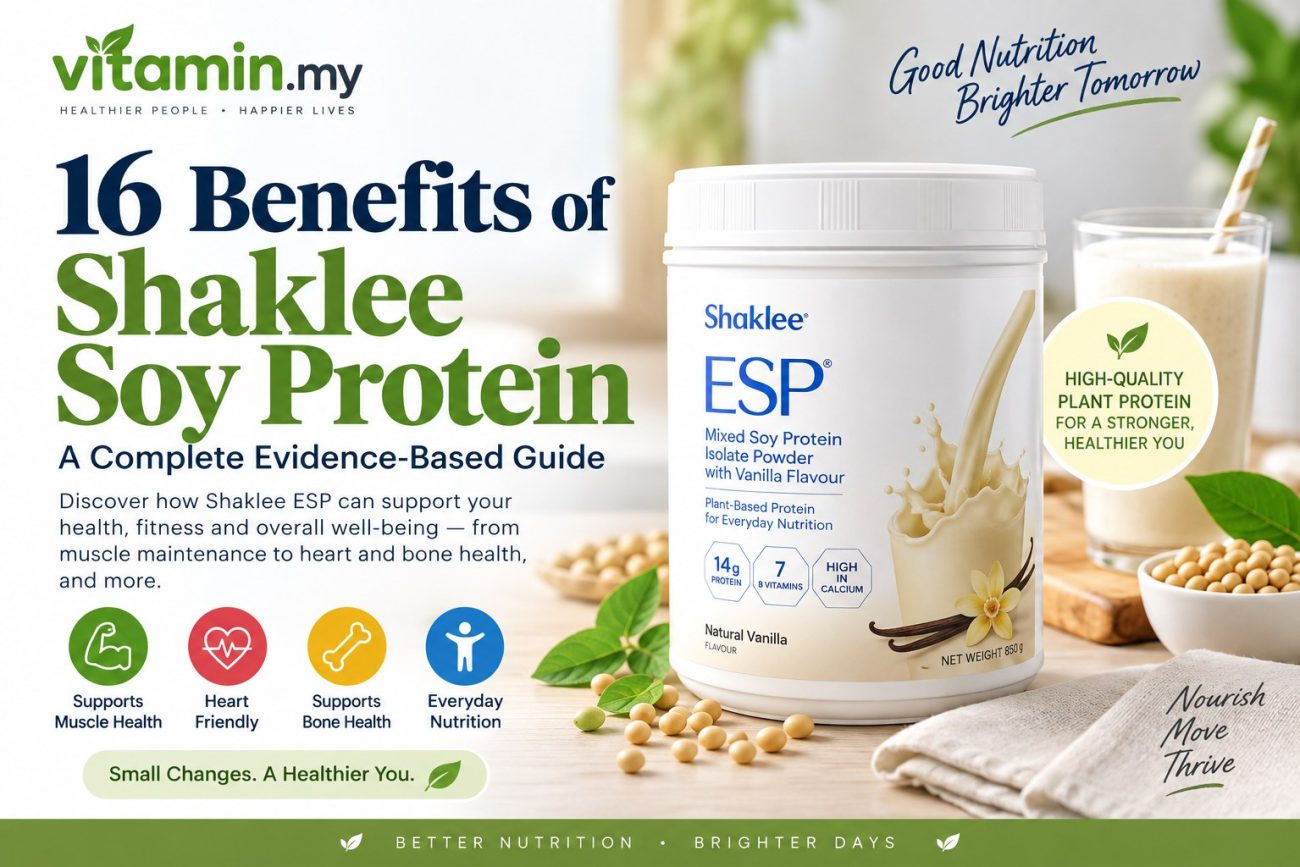
Shaklee ESP Mixed Soy Protein Isolate Powder is one of Shaklee Malaysia’s long-established protein products. The current Malaysian product information states that each serving provides 14 g of protein, together with seven B vitamins and calcium. Shaklee also states that its soy protein comes from non-genetically modified soy produced under an Identity Preservation Program.
But what exactly can soy protein do?
And are the health claims about soy really supported by modern research?
Let us look at the subject properly.
.png)
What Is Soy Protein?
Soybeans are unusual among plant foods because they provide a relatively high-quality protein containing all nine essential amino acids.
Essential amino acids are amino acids that our body cannot manufacture in sufficient quantities on its own. They therefore need to come from food.
These amino acids are required for processes including muscle protein synthesis, tissue repair and the production of enzymes and other proteins in the body.
Soy also naturally contains compounds called isoflavones, particularly genistein and daidzein.
Isoflavones are classified as phytoestrogens because their chemical structure allows them to interact weakly with certain estrogen receptors.
This has sometimes caused confusion.
Eating soy does not mean that you are consuming human estrogen.
A 2024 systematic review and meta-analysis involving 40 randomized trials and 3,285 postmenopausal women found no statistically significant effect of soy isoflavones on estradiol, FSH, endometrial thickness or vaginal maturation. The researchers concluded that soy isoflavones behave differently from the hormone estrogen itself.
With that background, here are 16 practical benefits of including a quality soy protein source such as Shaklee ESP in the diet.
1. Provides High-Quality Complete Plant Protein
One of the biggest nutritional advantages of soy is its protein quality.
Many plant proteins contain relatively low amounts of one or more essential amino acids. Soy is different because it supplies all nine essential amino acids required by humans.
That makes soy a useful protein source for people trying to increase plant protein without relying entirely on meat, chicken, fish or dairy products.
This does not mean that soy protein must replace all other protein sources.
A healthy diet can contain several protein sources such as eggs, fish, chicken, milk, yoghurt, beans, lentils, tofu, tempeh and soy protein.
The real advantage is flexibility.
If your meal is low in protein, adding soy protein can make it much easier to reach your daily protein requirement.
2. Helps You Reach Your Daily Protein Requirement
Many people focus on vitamins, minerals and supplements but forget the most basic building material in the body: protein.
Protein requirements vary according to body size, age, activity level and health condition.
Someone who exercises regularly may require more protein than someone who is sedentary.
Older adults may also need to pay closer attention to protein because ageing is associated with gradual muscle loss.
The challenge is not always knowing that protein is important.
The challenge is eating enough protein consistently.
A serving of Shaklee ESP currently provides about 14 g of protein, making it a convenient way to add protein to breakfast, snacks or meals that would otherwise be low in protein.
For example, compare:
Breakfast A: coffee + two slices of bread.
versus:
Breakfast B: bread + fruit + a protein drink.
The second breakfast provides a stronger protein component without requiring you to cook chicken or fish early in the morning.
3. Supports Muscle Maintenance
Muscle is not just for looking muscular.
Muscle is metabolically active tissue that helps us walk, climb stairs, carry groceries, maintain balance and remain physically independent as we age.
Every day, muscle proteins are continuously broken down and rebuilt.
Dietary protein provides the amino acids required for this rebuilding process.
Soy protein can contribute to this protein supply.
Modern studies comparing plant and animal proteins have produced an interesting result.
A recent meta-analysis found that while some non-soy plant proteins may produce slightly smaller increases in muscle mass than animal proteins, soy protein and milk protein did not show a significant difference in muscle-mass outcomes across the included randomized trials.
This is important because it challenges the old idea that plant protein is automatically “weak protein.”
Soy is actually one of the strongest plant-based alternatives available.
4. Can Support Muscle Building When Combined With Resistance Exercise
Simply drinking protein does not magically create large muscles.
Muscles need a reason to grow.
That reason is usually mechanical stress from activities such as resistance training.
This could include:
- lifting weights,
- resistance bands,
- squats,
- push-ups,
- stair climbing,
- carrying loads,
- bodyweight exercises.
Protein then provides the building materials.
A 2023 systematic review of randomized controlled trials involving physically active individuals found that soy protein supplementation could support muscle adaptations, with several studies reporting similar increases in lean mass compared with whey protein.
Therefore, the combination is much more important than the protein powder alone:
Resistance exercise + sufficient protein + sufficient calories + sleep + consistency.
That is the formula.
5. Useful for Maintaining Muscle as We Age
Starting around middle age, maintaining muscle becomes increasingly important.
Age-related loss of muscle mass and strength can eventually contribute to frailty, reduced mobility and loss of independence.
This does not mean everybody needs to become a bodybuilder at age 60.
Even simple activities such as squats, walking uphill, climbing stairs, resistance-band exercises and carrying groceries can stimulate muscle.
Protein provides the raw material required to maintain that tissue.
A systematic review involving older adults found that plant-protein interventions — all of which used soy protein in the included trials — produced muscle outcomes broadly comparable with control interventions including animal protein when combined appropriately with diet and exercise.
For older adults, however, the total amount of protein consumed throughout the entire day remains more important than relying on one scoop of protein powder.
6. Supports Exercise Recovery
After exercise, muscle proteins undergo repair and adaptation.
Protein supplies amino acids needed during this process.
This is why athletes commonly consume protein around training.
Soy protein can fulfil this role too.
Research in active individuals suggests soy protein can support training adaptations and recovery. Some trials have also examined possible effects on metabolic and oxidative-stress markers after exercise, although results vary between studies.
The practical lesson is simple.
You do not necessarily need an expensive “sports-only” protein product simply because you exercise.
A high-quality dietary protein can also contribute to post-exercise nutrition.
7. May Help Improve Satiety
Ever experienced this?
You eat breakfast at 8 am.
By 10 am you are already searching for biscuits.
One possible reason is that breakfast contains plenty of refined carbohydrates but very little protein or fibre.
Protein tends to be more satiating than rapidly digested carbohydrate alone.
That does not mean protein automatically causes weight loss.
However, increasing protein at meals may help some people stay satisfied longer, making calorie control easier.
For example:
Instead of:
sweet drink + bread
try:
protein + fruit + wholegrain carbohydrate
This creates a more balanced meal.
Soy protein can therefore be useful as part of a weight-management diet — not because it “burns fat,” but because it can help improve the overall protein quality of meals.
.png)
8. Can Be Useful During Weight-Loss Diets
When people try to lose weight, they commonly make one mistake.
They simply eat much less.
The scale drops, but the weight lost may include both fat and lean tissue.
Maintaining adequate protein intake during a calorie deficit is important because protein helps support lean body mass.
Research on higher-protein diets generally suggests that adequate protein becomes particularly important when someone is deliberately losing weight. A 2024 systematic review highlighted the importance of sufficient protein for preserving muscle mass during weight reduction in people with overweight or obesity.
Soy protein can contribute to that protein intake.
Again, however:
Soy protein is not a slimming drug.
You still need to consider:
- total calories,
- physical activity,
- sleep,
- food quality,
- muscle-strengthening exercise.
Think of protein as part of the strategy — not the entire strategy.
9. Soy Protein May Help Lower LDL Cholesterol
This is one of the better-established health effects of soy protein.
Older claims sometimes suggested dramatic cholesterol reductions of 20%, 30% or even 40%.
Modern evidence paints a more realistic picture.
A meta-analysis of 43 controlled trials identified by the US FDA found that consuming soy protein at a median intake of about 25 g per day for six weeks reduced LDL cholesterol by approximately 3–4% compared with non-soy protein controls.
That may sound modest.
But cardiovascular health is usually not determined by one dramatic intervention.
Small improvements from several habits can accumulate:
- replacing saturated-fat-rich foods,
- eating more fibre,
- maintaining healthy body weight,
- exercising,
- controlling blood pressure,
- avoiding smoking,
- consuming adequate plant foods.
Soy protein can be one piece of that larger lifestyle pattern.
10. A Heart-Friendly Alternative to Some Animal Proteins
The benefit of soy may come partly from what it replaces.
Imagine replacing a high-saturated-fat processed meat meal with tofu, tempeh or another plant protein.
You are not merely adding soy.
You are changing the overall nutritional composition of the meal.
This is an important concept called food substitution.
The health effect of any food depends partly on what it replaces.
Replacing vegetables with soy protein would not necessarily improve your diet.
Replacing some processed meat with soy foods, on the other hand, may improve the overall nutritional pattern.
Therefore, the best way to use soy is not to think:
“Soy is magic.”
Instead think:
“Soy is another useful high-quality protein option.”
11. Soy Intake May Have a Small Beneficial Effect on Blood Pressure
Soy has also been investigated for blood-pressure effects.
A systematic review and meta-analysis of randomized double-blind controlled trials found modest reductions of approximately 1.7 mmHg systolic and 1.3 mmHg diastolic compared with controls.
Another meta-analysis examining soy isoflavones found reductions in blood pressure, particularly in some longer-duration interventions and populations with prehypertension or metabolic syndrome.
Again, these changes are modest.
Soy should never replace prescribed blood-pressure medication.
Instead, it can form part of a heart-friendly dietary pattern that also emphasizes:
vegetables, fruit, whole grains, adequate potassium, physical activity, reduced excessive sodium intake and healthy body weight.
12. Soy Isoflavones May Support Bone Health After Menopause
Bone health becomes especially important for women after menopause because falling estrogen levels accelerate bone loss.
Soy isoflavones have therefore attracted considerable scientific attention.
A 2024 systematic review and meta-analysis of 63 randomized controlled trials involving thousands of postmenopausal women found improvements in bone mineral density at several skeletal sites among women receiving isoflavone interventions.
Another 2024 meta-analysis examining 73 randomized trials found that isoflavone interventions influenced several markers related to bone turnover.
This does not mean drinking soy protein alone will prevent osteoporosis.
Bone health also requires:
- resistance exercise,
- weight-bearing activity,
- sufficient protein,
- calcium,
- vitamin D,
- magnesium,
- adequate energy intake,
- avoidance of smoking.
But soy protein and soy isoflavones may complement these strategies.
13. Soy Isoflavones Are Not the Same as Human Estrogen
One of the most common myths about soy is:
“Soy has estrogen, so men shouldn’t drink it.”
That statement is misleading.
Soy contains phytoestrogens, mainly isoflavones.
Phytoestrogens are plant compounds.
They do not behave exactly like human estrogen.
A major 2024 systematic review of randomized trials in postmenopausal women found no significant changes in estradiol, FSH or several other measures of estrogenic activity after soy-isoflavone consumption.
So the phrase:
“Soy equals estrogen”
is scientifically inaccurate.
The biological effects of soy isoflavones are considerably more complicated.
14. Soy Foods Do Not Need to Be Feared Because of Breast Cancer Myths
Another old fear is that women — particularly breast cancer survivors — must completely avoid soy because soy contains phytoestrogens.
The evidence is more nuanced.
Observational studies of women consuming soy foods after breast cancer diagnosis have generally not shown increased recurrence. Some studies have actually found associations with improved survival and lower recurrence, although observational associations cannot prove that soy itself caused the benefit.
This is very different from claiming:
“Soy cures cancer.”
It does not.
Neither soy foods nor Shaklee ESP should be marketed as cancer treatment.
Anyone undergoing cancer treatment should discuss supplements and major dietary changes with their oncology team.
But the old blanket statement that ordinary soy consumption automatically “feeds cancer” is not supported by current evidence.
15. Shaklee ESP Also Provides B Vitamins and Calcium
Shaklee ESP is more than isolated protein alone.
The current Malaysian product listing states that it contains seven B vitamins and is rich in calcium, in addition to providing 14 g of protein per serving.
B vitamins participate in numerous metabolic pathways involved in converting food into usable energy.
Calcium is required for functions including normal bones, muscle contraction and nerve signalling.
However, it is important to understand what this means.
Taking B vitamins does not create unlimited energy.
And calcium alone does not guarantee strong bones.
Nutrition works as a system.
The advantage of a fortified protein product is that it can contribute several nutrients to the total daily diet.
16. It Is Convenient, Versatile and Easy to Add to Everyday Meals
Sometimes the biggest benefit of a nutritional product is not a mysterious ingredient.
It is simply convenience.
Many people know they should eat better but struggle because of time.
Cooking eggs, chicken or fish every time you need protein is not always practical.
Protein powder provides another option.
Shaklee recommends mixing ESP with milk, juice or another preferred beverage, and fruit can also be blended with it.
You can also use protein powder creatively in meals such as:
- oats,
- overnight oats,
- smoothies,
- yoghurt,
- high-protein breakfast bowls,
- homemade pancakes.
The objective is not to replace all real food with powder.
The objective is to use the powder where it solves a practical nutritional problem.
What About the Old Claims About Soy?
The original version of this article included several claims originating from older presentations about soy, including extremely large cholesterol reductions, cancer prevention, kidney protection and comparisons with cholesterol-lowering drugs.
Nutrition science has evolved considerably.
Today, it is more responsible to separate findings into three categories:
Well-supported evidence
Soy is a high-quality plant protein and can contribute to daily protein intake. Soy protein appears to produce modest LDL-cholesterol reductions.
Promising evidence
Soy isoflavones may have beneficial effects on bone health, particularly in postmenopausal women.
Claims that should not be made
Soy should not be described as curing cancer, reversing tumours, replacing medication or preventing every chronic disease.
Good health information does not need exaggerated claims.
The actual evidence for soy is already interesting enough.
Does Soy Damage the Thyroid?
Another common internet claim is that soy destroys thyroid function.
Current research does not support such a sweeping conclusion.
A systematic review and meta-analysis of randomized controlled trials found no significant effects of soy supplementation on free T3 or free T4. A very small increase in TSH was observed, but the researchers stated that the clinical significance was uncertain.
People taking thyroid medication should nevertheless follow their doctor’s instructions because food and supplements can sometimes affect medication absorption.
That is a medication-timing issue — not proof that soy inherently damages the thyroid.
What About Soy and Kidney Health?
The old article suggested that soy “protects the kidneys.”
That statement is too broad.
Protein requirements in people with kidney disease are complicated and depend on the stage of kidney disease, dialysis status, nutritional status and other medical factors.
Recent research is investigating whether replacing some animal protein with soy protein may influence markers of chronic kidney disease, but results remain an area of ongoing study.
Therefore, anyone with chronic kidney disease should follow the protein target recommended by their doctor or renal dietitian.
More protein is not automatically better.
.png)
Soy Protein vs Whey Protein: Which Is Better?
This question appears everywhere.
Whey contains a high concentration of essential amino acids and leucine and is rapidly digested, which explains its popularity among athletes.
But soy should not automatically be dismissed.
A recent meta-analysis comparing plant and animal proteins found no significant difference between soy and milk protein for muscle mass across 17 randomized trials.
Meanwhile, research in physically active individuals has shown that soy supplementation can support exercise adaptations.
The better question therefore may be:
Which protein fits your diet, preferences and lifestyle?
Someone who enjoys dairy may choose whey.
Someone who wants plant protein may choose soy.
Someone else may obtain enough protein entirely from food.
There is no requirement that everybody consume protein powder.
How Much Protein Do You Actually Need?
Do not confuse one serving of protein powder with your total daily protein requirement.
Protein needs vary.
For a healthy sedentary adult, the commonly cited minimum recommendation is around 0.8 g of protein per kilogram of body weight per day.
However, people who are older, exercising regularly, dieting or trying to gain muscle may benefit from higher intakes depending on their individual situation.
For example, a person weighing 70 kg should not think:
“I drank 14 g of protein today, so my protein requirement is finished.”
Protein powder should be counted together with protein from:
- fish,
- chicken,
- meat,
- eggs,
- milk,
- yoghurt,
- tofu,
- tempeh,
- beans,
- lentils,
- nuts and other foods.
Think of ESP as one contribution to the total.
A Better Way to Use Shaklee ESP
Instead of drinking protein randomly, identify where your diet is weakest.
Low-protein breakfast?
Add protein.
Always hungry before lunch?
Improve breakfast with protein, fibre and whole foods.
Exercising regularly?
Use protein around meals or training when it helps you reach your daily target.
Dieting?
Make sure calorie restriction does not result in extremely low protein intake.
Age 40, 50 or 60+?
Combine sufficient protein with resistance activity.
That is where protein becomes meaningful.
.png)
Final Thoughts
Soy has been eaten in Asian cultures for generations in foods such as tofu, tempeh, soy milk, miso and other traditional preparations.
Modern science has now studied soy from many different angles.
Some old claims were exaggerated.
Some fears were exaggerated too.
The scientific picture is far more balanced.
Soy is a high-quality plant protein.
It can contribute to muscle maintenance, exercise nutrition and daily protein requirements.
Research supports a modest cholesterol-lowering effect of soy protein.
Soy isoflavones are being studied for cardiovascular and bone-health effects, particularly among postmenopausal women.
And modern research does not support the simplistic idea that soy phytoestrogens behave exactly like human estrogen.
Shaklee ESP provides a convenient way to incorporate soy protein into the diet. Shaklee Malaysia currently states that a serving provides 14 g of protein together with seven B vitamins and calcium, using non-GMO soy protein produced under its Identity Preservation Program.
But remember this:
Protein powder is still food — not magic.
The strongest health strategy remains the combination of adequate protein, vegetables and fruit, minimally processed foods, regular movement, resistance exercise, sufficient sleep and overall calorie balance.
Use supplements to fill nutritional gaps.
Do not expect supplements to compensate for an unhealthy lifestyle.
That is the more realistic — and scientifically defensible — way to understand the benefits of Shaklee Soy Protein.
Disclaimer: This article is for general nutritional education and is not intended to diagnose, treat, cure or prevent any disease. Individuals with kidney disease, cancer, thyroid disease, food allergies or other medical conditions should discuss significant dietary or supplement changes with their healthcare professional
