Updated for 2026
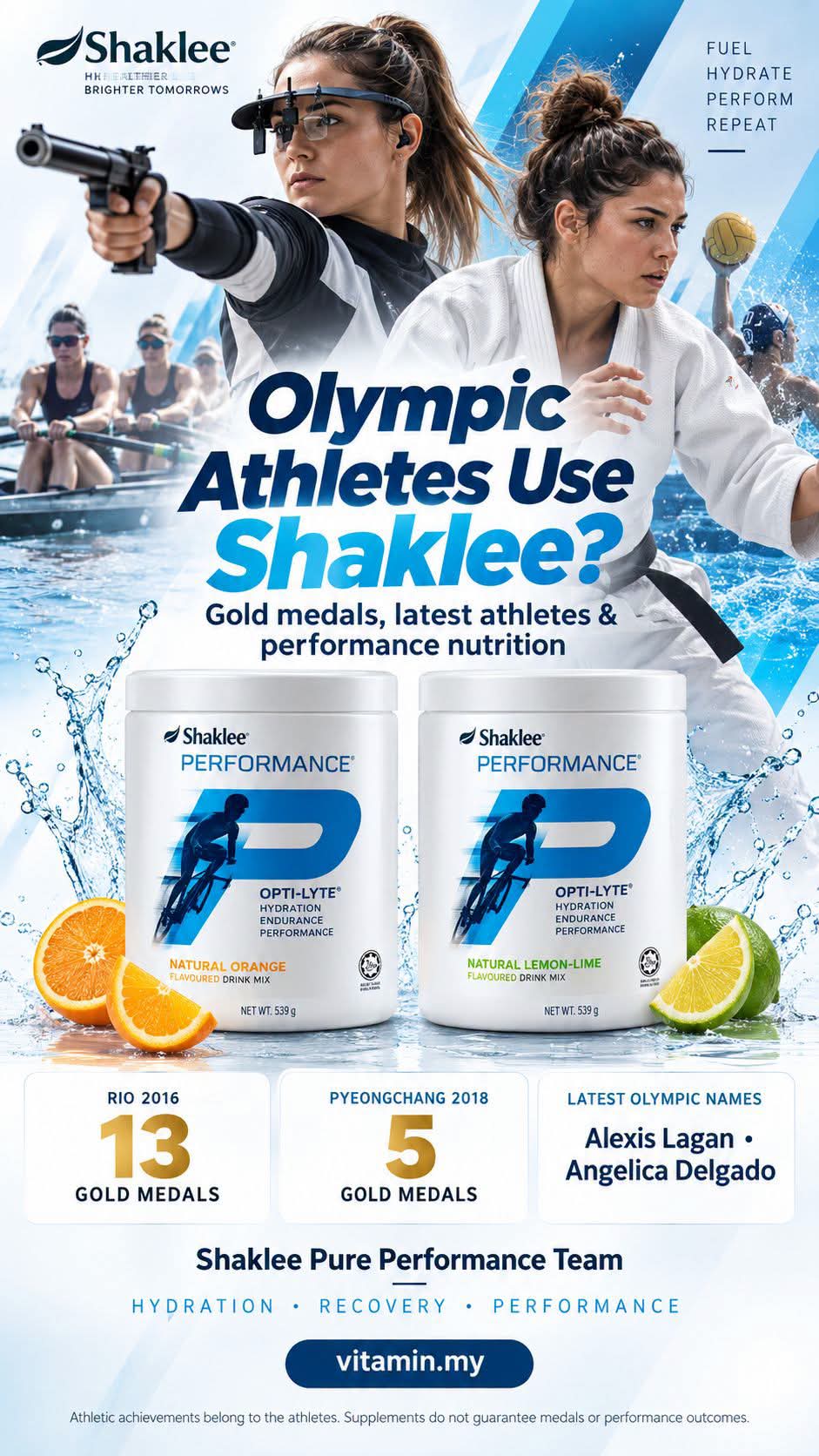
Do Olympic athletes really use Shaklee?
The answer is yes.
For decades, Shaklee has been associated with athletes competing at some of the highest levels of sport through its Pure Performance Team.
These athletes have competed in rowing, water polo, shooting, judo, curling, table tennis, cycling, ice hockey and other sports.
Some became Olympians.
Some returned home with silver or bronze medals.
And some became Olympic gold medalists.
According to Shaklee’s official athlete platform, athletes associated with the Pure Performance Team have accumulated a combined 146 gold, silver and bronze medals at the Summer and Winter Games.
That is an impressive history.
However, there is one very important point to understand before we go further.
We should not say:
“They won gold because they took Shaklee.”
That would be scientifically inaccurate.
Nobody becomes an Olympic champion because of one supplement.
Olympic performance comes from years—sometimes decades—of training, coaching, genetics, sports science, nutrition, recovery, sleep, technique, psychology, strategy and extraordinary consistency.
A nutritional supplement can support an athlete’s overall nutrition plan.
It does not create an Olympic champion by itself.
The more interesting question is this:
Why would world-class athletes, whose careers depend on their bodies performing at an extraordinary level, choose to include Shaklee products in their nutrition routines?
That is where the story becomes much more interesting.
Shaklee and Elite Athletes: A History That Goes Back Decades
Shaklee’s involvement in elite sport is not something that suddenly appeared during the Tokyo Olympics.
The company has supported world-class athletes for decades.
Its Pure Performance Team has included competitors from both Summer and Winter Games, and Shaklee says its athletes have now collectively won 146 Olympic and Games medals.
The current Shaklee athlete website continues to feature names including:
- Alexis Lagan — Shooting
- Angelica Delgado — Judo
- Amanda Polk — Rowing
- Colton Brown — Judo
- Mary Whipple — Rowing
- Tahl Leibovitz — Table Tennis
- Tyler George — Curling
These are the athletes currently featured on Shaklee’s official athlete platform as of the latest available site information.
Some are active competitors.
Others are important figures from Shaklee’s long history of elite sport.
And two particularly interesting names from the most recent Olympic cycle are Alexis Lagan and Angelica Delgado.
Both competed at the Paris 2024 Olympic Games.
NEW: Alexis Lagan — Paris 2024 Olympian and Shaklee Athlete
One of the most current examples is American shooter Alexis “Lexi” Lagan.
Shaklee’s official athlete page identifies Lagan as a Pure Performance athlete and specifically lists her participation in the 2024 Paris Games and the Tokyo 2020 Games.
Team USA confirms that she is a two-time Olympian, competing in Tokyo and Paris.
At Paris 2024, she finished 25th in the Women’s 10 m Air Pistol competition. At Tokyo 2020 she competed in three events: women’s 10 m air pistol, women’s 25 m pistol and mixed-team air pistol.
Her résumé extends far beyond Olympic participation.
Shaklee’s profile lists achievements including:
2022 Pistol National Championships
- Gold — 25 m Rapid Fire Pistol
- Gold — 10 m Air Pistol
2022 Championships of the Americas
- Gold — Women’s 10 m Air Pistol Team
- Silver — Women’s 10 m Air Pistol
- Silver — Women’s 25 m Pistol Team
She was also the 2018 Championship of the Americas gold medalist in Sport Pistol and earned the Olympic quota that eventually helped lead to her Tokyo appearance.
Before Paris, USA Shooting noted that Lagan had won silver in women’s air pistol at the 2023 Pan American Games, earning a U.S. Olympic quota place for Paris. She was also described as a six-time national champion.
That is serious sporting pedigree.
And here is where things become especially relevant to Shaklee.
Unlike simply appearing on an old sponsorship list, Lagan’s official Shaklee profile actually discusses the products she personally likes.
She mentions using Performance Physique + Bio-Build and Performance Endurance Electrolyte Drink as part of her routine.
That makes Lagan one of the clearest modern examples of an Olympic athlete publicly associated with Shaklee nutrition.
NEW: Angelica Delgado — Three-Time Olympian, Including Paris 2024
Another current name is American judoka Angelica Delgado.
This is an athlete with remarkable longevity.
Delgado competed at:
Rio 2016
Tokyo 2020
Paris 2024
That makes her a three-time Olympian.
Her Olympic progression is also interesting.
She finished 17th in Rio and improved to ninth at both Tokyo and Paris in the women’s 52 kg category.
Outside the Olympics, her career includes multiple international medals.
Shaklee lists her as:
- 3-time Grand Slam medalist
- 5-time Grand Prix medalist
- 9-time Senior Pan American Championships medalist
- 3-time Pan American Games bronze medalist.
USA Judo’s current profile similarly identifies her as a three-time Olympic team member and records an extensive international career.
Even after Paris 2024, Delgado remained active in international competition.
International Judo Federation records show her competing at the Paris Grand Slam in February 2025.
That is why Delgado is especially useful when talking about “latest Shaklee athletes.”
She is not merely somebody whose name appeared in an article from ten years ago.
Her Shaklee profile includes the Paris Games, and her competitive record extended into 2025.
Rio 2016: The Extraordinary 13-Gold-Medal Story
If we want to understand why the history of Shaklee and Olympic athletes became so widely discussed, Rio 2016 is probably the best place to look.
According to Shaklee’s post-Games announcement, Pure Performance Team athletes returned from Rio with:
16 total medals.
And incredibly:
13 of those were GOLD.
The gold medalists included members of the dominant U.S. Women’s Eight rowing team:
Amanda Elmore
Amanda Polk
Eleanor Logan
Emily Regan
Katelin Snyder
Kerry Simmonds
Lauren Schmetterling
Meghan Musnicki
They won Olympic gold in Women’s Eight Rowing.
Then there was the United States Women’s Water Polo team.
Shaklee athletes listed among those gold medalists included:
KK Clark
Kami Craig
Kaleigh Gilchrist
Courtney Mathewson
Melissa Seidemann
They also returned from Rio as Olympic champions.
Other Shaklee-associated medalists in Rio included cycling silver medalist Chloè Dygert and trap shooting bronze medalist Corey Cogdell.
So when people say Shaklee has been used by Olympic gold medalists, there really is a documented historical basis for that statement.
The important distinction is:
They were elite athletes who used Shaklee and won medals.
That is different from claiming:
Shaklee caused them to win those medals.
Why Rowing Is Such an Interesting Example
Take rowing.
An Olympic rowing race may not last very long, but the preparation behind it is enormous.
Elite rowers need extraordinary cardiovascular capacity, muscular endurance and power.
The body must repeatedly produce enormous force while maintaining highly precise technique.
Training volumes can be huge.
An athlete may perform endurance work, strength training, technical sessions and recovery work throughout the week.
Nutrition therefore becomes more than simply:
“What should I eat for dinner?”
The questions become:
Is the athlete eating enough calories?
Are glycogen stores being restored?
Is protein intake sufficient?
Are fluids being replaced?
Is sodium being replaced after heavy sweating?
Can the athlete recover quickly enough to perform tomorrow’s training session properly?
These tiny differences matter when you are trying to become one of the best athletes on Earth.
PyeongChang 2018: Another Five Olympic Gold Medals
Two years after Rio came the 2018 Winter Games in PyeongChang.
Once again, athletes associated with Shaklee reached the podium.
Shaklee reported that Pure Performance Team athletes won seven medals, including five gold medals.
The gold medalists included:
U.S. Women’s Ice Hockey
Kacey Bellamy
Dani Cameranesi
Emily Pfalzer
U.S. Men’s Curling
John Landsteiner
Tyler George
Shaklee athletes also won two bronze medals.
Figure skater Bradie Tennell earned bronze in the mixed team event, while Carlijn Schoutens won bronze in long-track speed skating team pursuit.
At that point Shaklee reported that its Pure Performance athletes had accumulated 144 medals across the Games.
The company’s more current athlete materials now place the figure at 146 medals.
Tokyo 2020: Not All Gold, But Still Elite-Level Performance
The original vitamin.my articles focused heavily on athletes heading to the Tokyo Games.
That history is worth keeping, but we should correct one possible misunderstanding.
The Shaklee athletes going to Tokyo did not all win gold medals.
Some did not medal.
Others did extremely well.
For example, several Shaklee-associated softball athletes were members of the United States team that won Olympic silver in Tokyo.
And American shooter Lucas Kozeniesky also won silver in the mixed-team air rifle event.
That distinction actually makes the article more credible.
Because the real story is not:
“Take this product and you will win.”
The real story is:
Athletes performing at the absolute highest level of global sport have chosen Shaklee as part of their nutrition routines.
There is a big difference.
Mary Whipple — Two-Time Olympic Gold Medalist
Another famous name still featured on Shaklee’s athlete platform is Mary Whipple.
Whipple was the coxswain of the powerful United States women’s rowing eight.
She won Olympic gold in:
Beijing 2008
London 2012
Her role illustrates something interesting about high-performance sport.
The coxswain may not be doing exactly the same physical work as the rowers, but the job requires intense concentration, leadership, race strategy and the ability to coordinate an elite crew under extreme competitive pressure.
Shaklee’s historical materials have featured Whipple discussing the importance of knowing what she puts into her body, particularly because elite athletes can be drug-tested.
That leads to another extremely important part of the Shaklee-athlete story.
Why Supplement Purity Matters Much More to an Olympic Athlete
For ordinary consumers, purchasing a poor-quality supplement could mean wasting money.
For an Olympic athlete, it could potentially destroy a career.
Elite athletes compete under strict anti-doping rules.
Under the principle of strict liability, athletes are generally responsible for prohibited substances found in their bodies.
That means supplement contamination is not a small issue.
An athlete cannot simply say:
“I didn’t know.”
That is why professional athletes, coaches, sporting bodies and sports dietitians can be extremely cautious when evaluating supplements.
The attraction of a sports nutrition company is therefore not simply:
“Does this have protein?”
They also want to know:
Who manufactured it?
What quality controls exist?
Is there a contamination risk?
Can the formulation be trusted?
Is the label accurate?
Shaklee emphasizes this area through what it calls its Pure Performance Guarantee.
Current Shaklee sports-nutrition pages state that products in its Performance line are guaranteed by the company to be safe and free from banned substances.
However, this should not be misrepresented as:
“WADA approved.”
WADA does not generally endorse dietary-supplement brands.
Competitive athletes should still check supplements according to their national federation, anti-doping organisation, team doctor or sports dietitian.
What Are Athletes Actually Trying to Achieve With Sports Nutrition?
This is probably the most useful part for ordinary people.
When an Olympic athlete uses sports nutrition, he or she is not normally thinking:
“I need more vitamins because vitamins are healthy.”
The thinking is much more specific.
They may be trying to solve one of several physiological problems:
How do I maintain energy?
How do I stay hydrated?
How do I replace electrolytes?
How do I restore glycogen?
How do I get enough protein?
How do I recover before my next session?
Those questions explain why sports nutrition products tend to fall into categories such as:
Fuel.
Hydration.
Protein.
Recovery.
1. Hydration: More Than Just Drinking Water
Shaklee’s Performance electrolyte products are designed around hydration during exercise.
Its current Electrolyte Mix uses the company’s OptiLyte electrolyte system together with carbohydrates and is positioned for endurance and hydration during physical activity.
Why combine carbohydrate and electrolytes with water?
Because sweat contains more than water.
When we sweat, we lose fluids and electrolytes, particularly sodium.
During short, light exercise, plain water may be perfectly adequate.
But the picture changes during:
long-duration exercise,
high-intensity exercise,
multiple training sessions,
heavy sweating,
or activity in very hot conditions.
Anyone who has exercised outdoors in Malaysia knows how quickly that can become relevant.
For an endurance athlete, hydration management can affect performance long before dehydration becomes medically serious.
2. Carbohydrates Are Fuel, Not Automatically the Enemy
Social media sometimes makes carbohydrate sound like a poison.
But sports physiology works differently.
Carbohydrates can be extremely useful fuel for working muscle.
The body stores carbohydrate partly as muscle and liver glycogen.
During prolonged or intensive exercise, glycogen availability can become important.
This is why endurance products frequently combine carbohydrate and electrolytes.
Shaklee’s current Performance Endurance formulation is designed around this concept: carbohydrate plus its electrolyte system to support energy and hydration during activity.
That does not mean everybody needs a carbohydrate sports drink.
Someone sitting in an office for eight hours does not have the same nutritional requirements as an athlete cycling hard for three hours.
Context matters.
And this is one lesson we can learn from athletes:
Nutrition should match demand.
3. Protein: The Raw Material for Recovery
Exercise creates a stimulus.
Recovery is where adaptation occurs.
Protein supplies amino acids the body needs for muscle protein synthesis and tissue maintenance.
That is why post-workout protein has become such a familiar part of sports nutrition.
Shaklee’s current sports range includes recovery protein products such as Performance Physique + Bio-Build and Advanced Physique whey protein formulations.
Again, protein powder is not magic.
An athlete can absolutely get protein from ordinary foods:
eggs,
fish,
chicken,
milk,
soy,
beans,
tempeh,
tofu,
meat,
yogurt.
The advantage of a shake is often convenience.
Imagine finishing training and needing another session later in the day.
A portable drink may be easier than cooking chicken and rice in the locker room.
That is where sports nutrition becomes practical.
4. Recovery Determines Whether Tomorrow’s Training Is Good or Bad
People sometimes judge training by how exhausted they feel afterwards.
Athletes think differently.
For an athlete, today’s session matters.
But tomorrow’s session matters too.
And the session after that.
High-level sport is about accumulating quality training over months and years.
If nutrition, sleep or recovery are constantly poor, training quality eventually suffers.
This is why Shaklee’s Performance range is structured not simply around “energy,” but around stages of exercise such as hydration, performance and recovery.
The product line even includes products formulated specifically around post-exercise recovery.
This broader approach makes more sense than looking for one miracle ingredient.
5. Convenience Is an Underrated Performance Tool
Athletes still eat real food.
Sports nutrition should not replace a healthy diet.
But elite athletes can train for hours every day.
Their schedules may include:
morning training,
strength work,
physiotherapy,
medical assessment,
technical sessions,
travel,
team meetings,
evening training,
and sleep preparation.
Eating perfectly prepared meals at exactly the right time is not always possible.
A sports drink or protein shake can therefore solve a logistical problem.
This principle also applies to ordinary people.
Sometimes the “best” nutritional option is not merely the most nutritionally perfect food on paper.
It is the option a person can consistently use in the real world.
Current Shaklee Athletes: What We Can Say in 2026
When this article was originally written around Tokyo 2020, most examples naturally came from that Olympic cycle.
Things have moved on.
As of the latest available official Shaklee athlete site, the company currently features:
Alexis Lagan — Shooting
Amanda Polk — Rowing
Angelica Delgado — Judo
Colton Brown — Judo
Mary Whipple — Rowing
Tahl Leibovitz — Table Tennis
Tyler George — Curling.
This should not automatically be interpreted to mean that every one of these athletes is currently competing professionally in 2026.
Some are historic champions or long-time members of the Pure Performance story.
But two names clearly connect Shaklee with the most recent Summer Olympic cycle:
Alexis Lagan
Paris 2024 and Tokyo 2020 Olympian in shooting.
Angelica Delgado
Paris 2024, Tokyo 2020 and Rio 2016 Olympian in judo, who also continued competing internationally in 2025.
This is important because it shows the athlete story did not simply stop after Tokyo.
The Most Impressive Numbers
If we wanted to summarise the history visually, these are probably the strongest numbers:
RIO 2016
37 Shaklee Pure Performance athletes
16 medals
13 GOLD medals
PYEONGCHANG 2018
7 medals
5 GOLD medals
SHAKLEE PURE PERFORMANCE HISTORY
146 combined gold, silver and bronze medals at the Summer and Winter Games, according to Shaklee’s current materials.
Those numbers are genuinely impressive.
But remember what they mean.
They mean Shaklee-associated athletes achieved these results.
They do not prove that taking a Shaklee product caused the medal.
Why That Distinction Actually Makes Shaklee’s Story Stronger
Sometimes marketers are tempted to exaggerate.
But exaggeration can make a strong story weaker.
Imagine saying:
“Drink this and become an Olympic champion.”
Nobody sensible believes that.
Instead say:
“Some athletes who reached the very highest level of international sport chose Shaklee as part of their nutrition strategy.”
Now that is interesting.
Because these athletes are among the most demanding consumers imaginable.
They train intensely.
They must recover quickly.
They need predictable nutrition.
They may undergo drug testing.
Their livelihood depends on performance.
The fact that Olympic-level athletes have historically included Shaklee products in their routines is worth discussing without inventing a miracle story around it.
What Ordinary People Can Learn From Olympic Athletes
Most of us will never compete at the Olympics.
That is okay.
The lesson is not that we need to eat exactly like an Olympian.
The lesson is how seriously elite performers treat the basics.
They do not simply exercise hard and hope everything else works itself out.
They pay attention to:
sleep,
hydration,
food quality,
energy intake,
protein,
carbohydrates,
recovery,
consistency.
Supplements come after those fundamentals.
This principle is just as relevant for someone aged 40, 50 or 60 who wants to preserve muscle and stay active.
We may not need Olympic-level nutrition.
But our bodies still need raw materials to function.
Don’t Copy an Athlete’s Supplement Routine Blindly
There is also another lesson.
Do not look at an Olympic athlete taking a particular product and assume:
“If they take two scoops, I need two scoops.”
The nutritional requirements of an elite rower weighing 90 kg and training several hours a day are completely different from those of an office worker who walks 4,000 steps per day.
Sports nutrition is personal.
The correct strategy depends on:
body weight,
training type,
training duration,
climate,
sweat rate,
total calorie needs,
medical conditions,
competition schedule,
and overall diet.
Products should fit the person.
The person should not be forced to fit the product.
The Real Secret of Olympic Performance
After looking through decades of Shaklee athletes, there is a much better lesson than simply asking:
“Which supplement did they take?”
Look at what these athletes do every day.
They train consistently.
They eat with purpose.
They recover.
They repeat movements thousands of times.
They practise even when motivation disappears.
They manage sleep.
They manage hydration.
They manage injuries.
They work with coaches.
And they continue for years.
That is the part nobody can buy in a bottle.
Shaklee may provide nutritional products that become one component of that environment.
But the medal belongs to the athlete.
From Olympic Gold Medalists to Paris 2024
That is why Shaklee’s athlete story remains interesting today.
The history includes Olympic champions such as members of the U.S. Women’s Eight rowing team and U.S. Women’s Water Polo team in Rio.
It includes Winter Olympic gold medalists from U.S. Women’s Ice Hockey and U.S. Men’s Curling.
It includes two-time rowing Olympic champion Mary Whipple.
And today the official Shaklee athlete platform also connects the story with the latest Olympic cycle through Paris 2024 Olympians Alexis Lagan and Angelica Delgado.
Lagan represents shooting—a sport demanding extreme concentration, stability and precision.
Delgado represents judo—a sport involving explosive power, conditioning, strength, skill and tactical intelligence.
Completely different sports.
Yet both illustrate the same broader principle:
Elite performance requires more than training alone.
Final Thoughts: Did Shaklee Create These Olympic Champions?
No.
And Shaklee does not need that claim for the story to be impressive.
What we can truthfully say is this:
World-class athletes have used Shaklee.
Olympic gold medalists have been members of Shaklee’s Pure Performance Team.
Pure Performance athletes won 13 gold medals at Rio 2016.
They won another five gold medals at PyeongChang 2018.
Shaklee currently states that athletes associated with its Pure Performance programme have accumulated 146 gold, silver and bronze medals at Summer and Winter Games.
And the story continued into the most recent Summer Olympics.
Alexis Lagan represented the United States at Paris 2024 in shooting.
Angelica Delgado competed in her third Olympic Games at Paris 2024 in judo.
Both remain featured on Shaklee’s official athlete platform.
Perhaps that is the better way to look at sports nutrition.
Do not ask:
“What supplement will make me a champion?”
Ask:
“How can I give my body what it needs so that my training actually has a chance to work?”
Fuel properly.
Hydrate properly.
Get enough protein.
Sleep.
Recover.
Train.
Repeat.
Elite athletes have understood this for decades.
The supplement is only one piece.
The real performance system is the entire lifestyle.
And maybe that is the most valuable lesson we can learn from the Olympic champions who have been powered by Shaklee.
Important Note
This article is for general educational purposes. Supplements do not replace a balanced diet, medical care, appropriate training or adequate rest. The sporting achievements described belong to the athletes themselves and should not be interpreted as evidence that Shaklee products caused their Olympic results.
Competitive athletes are responsible for complying with the anti-doping rules that apply to their sport and should independently verify supplements with appropriate sports-medicine, dietetic and anti-doping professionals.
Suggested Yoast SEO Title
Olympic Athletes Who Use Shaklee: Gold Medals, Paris 2024 Athletes & Performance Nutrition
Focus Keyphrase
Shaklee Olympic athletes
SEO Slug
shaklee-olympic-athletes-gold-medal
Meta Description
Discover Olympic athletes who use Shaklee, including Paris 2024 Olympians Alexis Lagan and Angelica Delgado, plus Shaklee Pure Performance gold medalists from Rio and PyeongChang and how sports nutrition supports hydration, recovery and performance.
