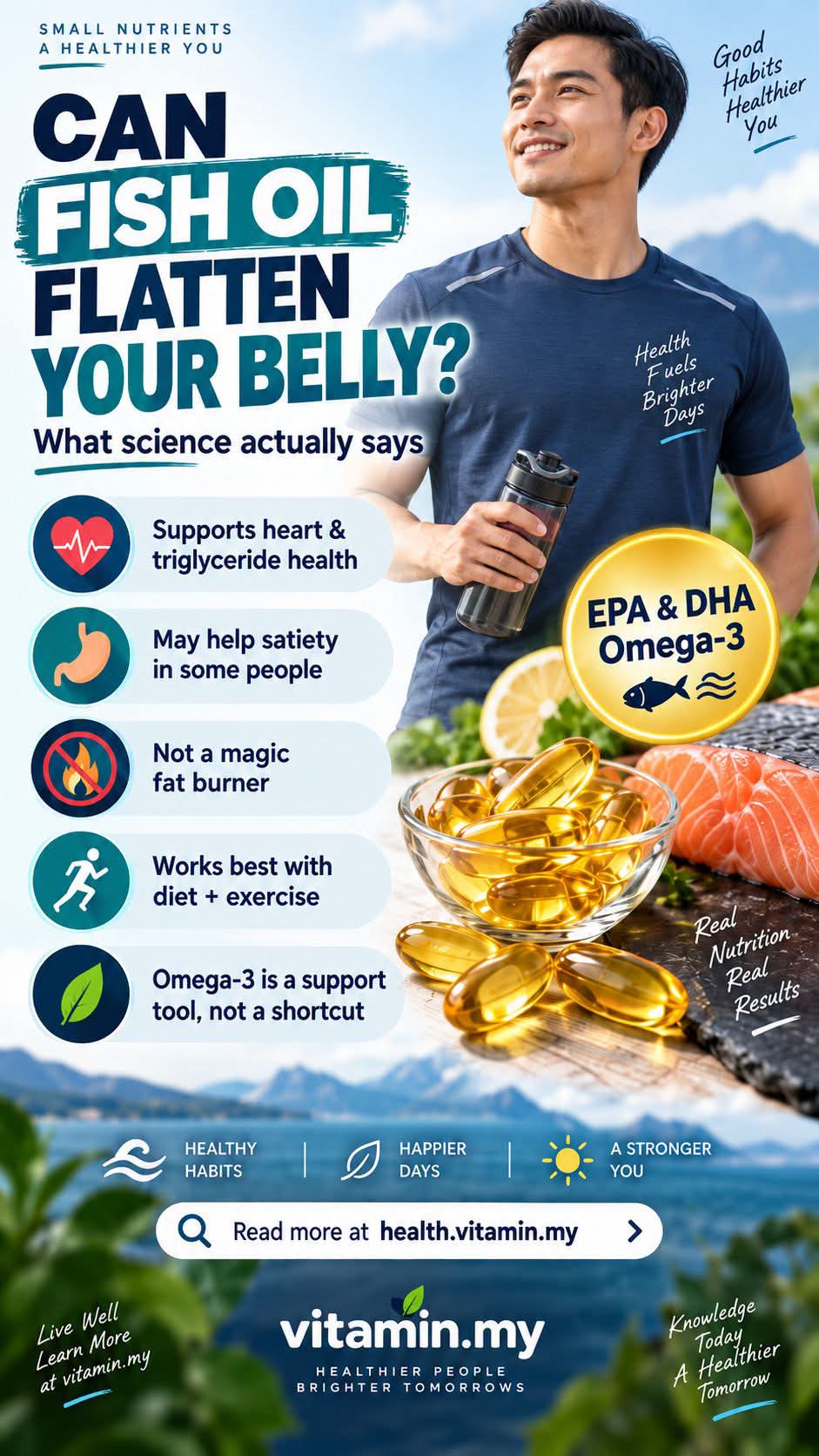
Struggling with stubborn belly fat?
You exercise. You try to eat less. You cut sugar for a few days. You even avoid rice at night.
Yet when you look in the mirror, the stomach seems to be the last place that wants to change.
This is why claims about fish oil and belly fat sound so attractive.
Omega-3 fish oil has been linked to heart health, triglyceride control, inflammation, brain function and metabolic health. Some studies have also suggested that omega-3 fatty acids may influence body composition, appetite, fat oxidation and even waist circumference.
But does that mean taking a few fish oil capsules every day will magically flatten your belly?
Not exactly.
The scientific evidence is much more interesting than that.
Fish oil is not a fat-melting supplement. It cannot selectively burn abdominal fat while leaving the rest of the body untouched. However, omega-3 fatty acids—particularly EPA and DHA—may influence several biological processes involved in metabolism, cardiovascular health and body composition.
Under the right circumstances, omega-3 may therefore become one useful piece of a much larger fat-loss puzzle.
Let us examine what the science actually says.
What Exactly Is Belly Fat?
When people talk about belly fat, they often assume all abdominal fat is the same.
It is not.
There are two major types.
1. Subcutaneous Fat
This is the fat located directly underneath the skin.
It is the soft fat you can usually pinch around your abdomen, hips or thighs.
Although excessive amounts may still contribute to health problems, subcutaneous fat is generally considered less metabolically harmful than visceral fat.
2. Visceral Fat
Visceral fat is stored deeper inside the abdominal cavity surrounding organs such as the liver and intestines.
This type of fat is particularly important because excessive visceral fat is associated with metabolic disturbances including insulin resistance, abnormal blood lipids and increased cardiovascular risk.
This explains why waist circumference can sometimes tell us something that body weight alone cannot.
A person may lose only a small amount of weight on the scale but still improve waist circumference and metabolic health.
This distinction becomes important when discussing omega-3.
Fish oil does not appear to produce dramatic weight loss by itself. Some earlier meta-analyses, however, reported small reductions in waist circumference even when changes in total body weight were limited. One meta-analysis of randomized trials found approximately a 0.53 cm greater reduction in waist circumference with omega-3 supplementation, although researchers cautioned that the number and quality of trials were limited.
So perhaps the better question is not:
“Will fish oil make me lose weight?”
It is:
“Could omega-3 support the metabolic environment that makes healthy body composition easier to achieve?”
That is a much more scientifically reasonable question.
What Is Actually Inside Fish Oil?
The two omega-3 fatty acids receiving most scientific attention are:
EPA — Eicosapentaenoic Acid
and
DHA — Docosahexaenoic Acid
Another omega-3 called ALA is found mainly in foods such as flaxseed, chia seeds, walnuts, soybean oil and canola oil.
The human body can convert some ALA into EPA and DHA, but conversion is limited. For this reason, consuming EPA and DHA directly through fish, seafood, fish oil or algae-derived omega-3 is the most practical way to substantially increase EPA and DHA levels in the body.
Fatty fish such as sardines, salmon, mackerel, herring and tuna can provide EPA and DHA naturally.
Fish oil supplements simply provide a concentrated source.
One important detail many people miss is that:
1,000 mg of fish oil does NOT necessarily mean 1,000 mg of omega-3.
A typical fish oil capsule may contain much less EPA plus DHA than its total oil weight.
Therefore, when comparing products, it is usually more useful to look at the actual amounts of:
EPA + DHA
rather than simply reading “1,000 mg fish oil” on the front label.
1. Can Omega-3 Reduce Hunger?
This is one of the most popular claims surrounding fish oil.
The theory is attractive:
Omega-3 improves satiety → you naturally eat less → calorie intake decreases → belly fat eventually decreases.
There is some scientific support for this idea, but it is not as straightforward as many supplement advertisements suggest.
A 2008 study published in Appetite examined overweight and obese adults following an energy-restricted diet.
Participants consuming higher amounts of long-chain omega-3 fatty acids reported greater fullness and lower hunger after a meal compared with participants consuming lower amounts.
Researchers concluded that omega-3 intake appeared to influence post-meal satiety during weight loss.
Sounds promising.
But newer evidence makes the picture more complicated.
A systematic review and meta-analysis published in 2024 examined controlled clinical trials of omega-3 supplementation and appetite.
Researchers found no significant improvement in overall appetite score. Interestingly, omega-3 supplementation even modestly increased the desire to eat in some analyses.
Another controlled trial found no meaningful difference in appetite, food intake, resting energy expenditure, leptin or ghrelin between omega-3 and control diets.
Therefore, it would be inaccurate to say:
“Fish oil suppresses appetite.”
A more accurate conclusion is:
Omega-3 may influence satiety under certain conditions and populations, but appetite suppression is not consistent enough to consider fish oil an appetite suppressant.
This is important.
If somebody eats 3,500 calories every day while requiring only 2,000–2,500 calories, swallowing omega-3 capsules is unlikely to compensate for that calorie surplus.
2. Can Fish Oil Increase Fat Burning?
Another proposed mechanism involves fat oxidation.
Fat oxidation simply means using fatty acids as fuel.
Your body constantly switches between carbohydrates and fats depending on factors such as:
- food intake,
- insulin levels,
- exercise intensity,
- physical activity,
- energy requirements,
- glycogen availability,
- hormones,
- sleep,
- and overall metabolic health.
Laboratory research suggests omega-3 fatty acids may influence pathways involved in lipid metabolism and fat oxidation.
But there is an important distinction.
Burning More Fat Does Not Automatically Mean Losing More Body Fat
Imagine your body burns slightly more fat during part of the day but you also eat more calories overall.
Your body can simply store additional energy later.
Fat loss occurs over time when energy expenditure exceeds energy intake sufficiently for stored energy to be mobilised.
This is why many substances that theoretically increase “fat oxidation” fail to produce meaningful long-term weight loss.
Omega-3 may influence fat metabolism, but that does not make it a substitute for energy balance.
3. The Famous Fish Oil + Exercise Study
One study frequently mentioned in discussions about fish oil and body fat came from researchers at the University of South Australia.
Overweight adults with cardiovascular risk factors were assigned to groups receiving either fish oil or sunflower oil, with some participants also performing regular aerobic exercise.
Participants taking fish oil consumed 6 grams of tuna fish oil daily, providing approximately 1.9 grams of omega-3 fatty acids.
The exercise groups walked three days per week for 45 minutes at approximately 75% of their age-predicted maximum heart rate.
After 12 weeks, fish oil supplementation and exercise were independently associated with reductions in body fat.
Fish oil also improved triglycerides and several cardiovascular markers.
This study is interesting.
But notice something important.
It did not prove that fish oil specifically melted abdominal fat.
It also does not mean everyone taking the same dose will experience the same result.
Nutrition research must be interpreted from the totality of evidence rather than one exciting study.
4. What Do Meta-Analyses Say About Fish Oil and Weight Loss?
Meta-analyses combine results from multiple studies.
They therefore give us a better overview than relying on one individual trial.
An earlier systematic review and meta-analysis found that people consuming fish or omega-3 supplements lost approximately:
- 0.59 kg more body weight,
- 0.49% more body fat,
- and about 0.81 cm more waist circumference
than comparison groups.
These are relatively small differences, not dramatic transformations.
Other meta-analyses found something particularly interesting.
Omega-3 did not consistently reduce body weight, yet some analyses reported small reductions in waist circumference.
However, later systematic reviews became more cautious.
A 2021 systematic review examining human studies concluded that the evidence was inconsistent: some studies found improvements in weight or body fat, whereas many others found no meaningful effects.
Then came an important 2025 systematic review and meta-analysis.
Researchers analysed 11 randomized trials involving 637 overweight or obese adults undergoing calorie restriction.
Their conclusion?
Adding long-chain omega-3 supplementation did not significantly improve fat loss, body weight or preservation of fat-free mass compared with calorie restriction alone.
That provides an important reality check.
Fish oil is not a weight-loss drug.
If somebody takes omega-3 but continues:
- overeating,
- sleeping poorly,
- barely moving,
- consuming excessive ultra-processed foods,
- drinking sugary beverages,
- and losing muscle,
the supplement is unlikely to rescue the situation.
5. Omega-3 and Triglycerides: This Is Where Evidence Is Much Stronger
While evidence for omega-3 as a fat-loss supplement is inconsistent, its effect on blood triglycerides is much better established.
EPA and DHA can lower triglyceride concentrations, especially at therapeutic doses used under medical supervision.
The NIH Office of Dietary Supplements notes that fish oil and long-chain omega-3 supplements lower triglyceride levels, although effects on other cardiovascular outcomes vary according to population and dose.
Why does this matter when discussing belly fat?
Because excessive abdominal fat often travels together with other metabolic problems such as:
- elevated triglycerides,
- insulin resistance,
- fatty liver,
- hypertension,
- low physical activity,
- and poor dietary quality.
Therefore, omega-3 may be valuable for certain people even if the bathroom scale barely moves.
Health improvement is bigger than weight loss.
6. Omega-3 and Visceral Fat
Could omega-3 have special effects on visceral adiposity?
Research remains preliminary.
One randomized controlled trial involving people with type 2 diabetes and non-alcoholic fatty liver disease found improvements in several indirect measures associated with fatty liver and visceral adiposity after 12 weeks of omega-3 supplementation.
The omega-3 group received 2,000 mg per day.
However, these indices are not equivalent to proving large amounts of visceral fat physically disappeared.
Other trials have examined omega-3 activity directly inside adipose tissue.
Some have reported reductions in inflammatory markers within visceral or subcutaneous fat tissue.
Yet another six-month randomized trial using high-dose EPA and DHA found large increases in omega-3 concentrations inside plasma and adipose tissue but no significant improvements in several measures of adipose tissue inflammation or insulin-regulated fat breakdown.
Again, the message is consistent:
biology is complicated.
Omega-3 clearly enters body tissues and influences many biochemical pathways, but swallowing more omega-3 does not automatically translate into visible abdominal fat loss.
7. Does Fish Oil Increase Muscle?
This is another interesting area.
Muscle matters enormously when discussing belly fat.
Not because muscle magically burns thousands of calories while you sleep, but because maintaining adequate muscle supports:
- physical function,
- glucose disposal,
- insulin sensitivity,
- exercise capacity,
- long-term weight maintenance,
- and overall metabolic health.
A small six-week randomized trial in healthy adults found that participants receiving fish oil gained approximately 0.5 kg of fat-free mass and lost around 0.5 kg of fat mass compared with participants receiving safflower oil.
Interestingly, however, resting metabolic rate did not significantly increase.
Therefore, the common statement:
“Fish oil builds muscle, which massively increases metabolism”
is too simplistic.
Omega-3 is being studied for potential effects on muscle protein metabolism and muscle preservation, but resistance exercise and adequate protein intake remain much more important.
And the 2025 meta-analysis of overweight and obese adults undergoing calorie restriction did not find significant preservation of fat-free mass from omega-3 supplementation.
8. Exercise Changes the Entire Conversation
If your real goal is a flatter stomach, exercise matters far more than most supplement discussions suggest.
And not just abdominal exercises.
Doing 500 sit-ups does not force your body to remove fat directly from your abdomen.
You cannot meaningfully choose where your body removes stored fat first.
Instead, think about total activity.
A good programme may include:
Walking
Walking is underrated.
Thirty to sixty minutes of walking adds meaningful daily energy expenditure without creating the fatigue associated with intense exercise.
Resistance Training
Squats, push-ups, rows, lunges, presses, pull-downs and other resistance movements help preserve or build muscle.
This becomes increasingly important after age 40.
Aerobic Training
Cycling, brisk walking, jogging, swimming and similar activities improve cardiovascular fitness and increase total energy expenditure.
NEAT
NEAT means Non-Exercise Activity Thermogenesis.
It includes normal movements such as:
- walking around the office,
- doing housework,
- gardening,
- climbing stairs,
- shopping,
- standing,
- cleaning,
- and moving throughout the day.
Someone exercising 30 minutes daily but sitting for the remaining 15 waking hours may have lower total daily activity than someone who constantly walks and moves.
This is why lifestyle beats the “one magic supplement” mentality.
9. Protein May Matter More Than Most People Realise
If you are trying to reduce abdominal fat, do not concentrate only on eating less.
Pay attention to what you eat.
Protein is particularly useful because it supports muscle maintenance and generally provides good satiety.
Examples include:
- fish,
- eggs,
- chicken,
- lean meat,
- tofu,
- tempeh,
- soy,
- milk,
- yogurt,
- legumes,
- and other protein-rich foods.
A weight-loss diet that causes excessive muscle loss may leave someone lighter on the scale without producing the body composition they expected.
That is why the goal should not simply be:
“lose weight.”
A better target is:
lose excess fat while preserving muscle and improving metabolic health.
10. Fibre Is Another Secret Weapon
Before spending too much money searching for exotic fat burners, examine your fibre intake.
Vegetables, fruit, legumes and whole grains can increase food volume and help with satiety.
For example, compare:
A sweet drink + pastry
with
rice + vegetables + fish + fruit.
Both can contain calories, but the second meal usually provides much more protein, fibre, micronutrients and food volume.
You do not need to remove carbohydrates completely.
You need a dietary pattern you can consistently maintain.
11. What About Rice and Carbohydrates?
Rice did not suddenly create the global obesity epidemic.
And carbohydrates do not automatically become belly fat simply because you eat them.
Excess calories matter.
Diet quality matters.
Portion size matters.
Physical activity matters.
Protein and fibre matter.
Sleep matters.
The combination matters.
A person eating moderate rice portions alongside fish, vegetables and adequate protein while remaining physically active may have a very different metabolic outcome from somebody consuming sugary drinks, desserts, fried food and huge portions while barely moving.
Avoid turning a single nutrient into the villain.
12. Sleep Can Sabotage Your Belly-Fat Plan
You could have an excellent supplement routine and still struggle if you consistently sleep five hours per night.
Poor sleep can affect:
- appetite regulation,
- food choices,
- energy,
- exercise performance,
- glucose regulation,
- and overall adherence to a healthy lifestyle.
When people are exhausted, they often move less and gravitate toward high-energy convenience foods.
So before searching for another fat-burning supplement, ask:
How is my sleep?
It sounds boring.
But boring habits often produce better long-term results than exciting hacks.
13. Stress Also Matters
Chronic stress can influence eating behaviour, sleep quality and physical activity.
Some people lose appetite when stressed.
Others crave:
- sweets,
- chocolate,
- fried food,
- sweet drinks,
- and highly processed snacks.
Therefore, stress management is not simply about feeling relaxed.
It may indirectly influence your ability to maintain the habits required for healthy body composition.
Again, fish oil cannot compensate for an entire lifestyle working against you.
14. Food First: Best Natural Sources of Omega-3
Supplements are convenient.
But omega-3 can also come from food.
Fatty fish are among the richest sources of EPA and DHA.
Examples include:
- sardines,
- salmon,
- mackerel,
- herring,
- tuna,
- and certain other seafood.
Plant foods such as:
- chia seeds,
- flaxseed,
- walnuts,
- soybean,
- and canola oil
provide ALA.
However, conversion of ALA into EPA and DHA is limited, which is why marine foods or algae-derived omega-3 remain important direct sources.
For many people, the ideal approach is not:
food OR supplements.
It is:
build a good diet first and use supplements when appropriate.
15. How Much Fish Oil Should You Take?
This is where consumers need to be careful.
Do not automatically copy doses used in research studies.
A clinical trial may use several grams of fish oil or EPA/DHA because researchers are studying a specific biological outcome under controlled conditions.
That does not mean everybody should take the same amount.
The NIH notes that doses vary substantially among omega-3 products.
High-dose omega-3 is also used medically for specific conditions such as elevated triglycerides, which should not be confused with ordinary nutritional supplementation.
Check the label for the actual amount of:
EPA + DHA per serving.
Not just total fish oil.
People with medical conditions or those using prescription medication should discuss higher-dose supplementation with a healthcare professional.
16. More Is Not Always Better
Omega-3 has a generally good safety profile, but that does not mean unlimited doses are desirable.
Common side effects may include:
- fishy aftertaste,
- bad breath,
- heartburn,
- nausea,
- gastrointestinal discomfort,
- and diarrhoea.
The NIH also notes potential interactions with medications, particularly anticoagulants at higher omega-3 doses.
Very high-dose omega-3 supplementation has also been associated in some large trials with a small increase in atrial fibrillation risk among people with cardiovascular disease or at high cardiovascular risk.
Therefore:
more capsules do not necessarily produce more benefits.
Use supplements intelligently.
17. How to Choose a Fish Oil Supplement
Rather than looking only at the biggest number on the bottle, consider:
EPA and DHA Content
Look at how much EPA and DHA each serving actually provides.
Quality
Fish oils should be manufactured and stored properly because polyunsaturated fats can oxidise.
Purification
Quality manufacturers generally use purification and quality-control processes to minimise contaminants.
According to the NIH, methylmercury found in some seafood is generally removed during fish-oil supplement processing and purification.
Consistency
A supplement you take regularly according to an appropriate dose is more useful than an expensive product sitting unopened in a cupboard.
18. So Can Fish Oil Flatten Your Belly?
Now we can finally answer the question.
If by “flatten your belly” you mean:
Take fish oil, change nothing else, and watch abdominal fat disappear…
The evidence says:
No.
Fish oil is not a magic belly-fat burner.
The latest evidence does not show reliable, substantial weight loss from omega-3 supplementation alone. A 2025 meta-analysis specifically examining omega-3 during calorie restriction found no additional significant reduction in fat mass or body weight.
But if you mean:
Could omega-3 support overall metabolic health while I improve diet, exercise, activity and body composition?
Then the answer becomes much more interesting.
Omega-3 may:
- support healthy triglyceride levels,
- influence lipid metabolism,
- affect inflammatory pathways,
- support cardiovascular health,
- possibly influence body composition in certain populations,
- and complement a healthy lifestyle.
But think of it as a supporting actor, not the hero of the movie.
The Real Belly-Fat Formula
If you genuinely want to reduce abdominal fat, concentrate on the fundamentals.
1. Create a Sustainable Energy Deficit
You do not need to starve.
Reduce unnecessary calories while keeping meals nutritious.
2. Eat Enough Protein
Protect your muscle while losing weight.
3. Eat More Whole Foods
Build meals around vegetables, fruit, protein, legumes and minimally processed foods.
4. Move More Every Day
Do not depend entirely on formal exercise.
Walk.
Use stairs.
Garden.
Clean.
Move.
5. Perform Resistance Exercise
Muscle is metabolic machinery worth protecting.
6. Add Cardiovascular Exercise
Walking, cycling, swimming or other aerobic activity can improve cardiovascular fitness and increase energy expenditure.
7. Sleep Properly
Do not treat sleep as optional.
8. Manage Stress
A lifestyle you cannot maintain eventually collapses.
9. Include Omega-3-Rich Foods
Fish provides omega-3 together with protein and other nutrients.
10. Consider Fish Oil as a Supplement—Not a Shortcut
That distinction changes everything.
What Should You Measure?
Another common mistake is judging progress only by body weight.
If you want to know whether your lifestyle is working, consider monitoring:
- waist circumference,
- body weight trend,
- how your clothes fit,
- exercise performance,
- strength,
- daily energy,
- blood pressure,
- triglycerides,
- blood glucose where appropriate,
- and other health markers recommended by your doctor.
Body weight can fluctuate because of:
- water,
- sodium intake,
- glycogen,
- food in the digestive tract,
- hormones,
- and bowel contents.
One bad reading does not mean your programme failed.
Look at trends.
Stop Searching for One Nutrient to Fix Everything
Perhaps the biggest lesson from omega-3 research is not actually about fish oil.
It is about how we think about nutrition.
We constantly ask:
What food burns fat?
What supplement suppresses appetite?
What vitamin speeds metabolism?
What drink removes belly fat?
But human metabolism does not operate through one magical switch.
Your body responds to thousands of interacting signals.
Food.
Muscle.
Movement.
Sleep.
Hormones.
Stress.
Age.
Genes.
Environment.
Energy intake.
Energy expenditure.
Diet quality.
Fish oil may influence some of these pathways.
But it cannot replace the whole system.
Final Verdict: Fish Oil for Belly Fat — Fact or Fiction?
It is neither completely fact nor completely fiction.
The exaggerated version is fiction:
Fish oil does not selectively melt abdominal fat.
The scientifically reasonable version is this:
Omega-3 fatty acids such as EPA and DHA have legitimate metabolic and cardiovascular effects. Some clinical studies and earlier meta-analyses have found small improvements in body fat or waist circumference, while other trials and newer reviews have found little or no additional weight-loss effect.
Research on appetite is also mixed. An earlier study showed improved satiety during an energy-restricted diet, whereas a newer meta-analysis found no overall appetite-suppressing effect.
That is exactly how good nutrition science should be interpreted.
Not:
“One study says it works, therefore it works.”
And not:
“One study says it doesn’t work, therefore it is useless.”
Instead, look at the entire body of evidence.
Fish oil may be useful.
Omega-3 is nutritionally important.
Its benefits extend far beyond the number on your weighing scale.
But if your goal is a flatter stomach, build the foundation first:
Eat better.
Eat enough protein.
Move every day.
Lift something heavy.
Walk more.
Sleep properly.
Control overall calorie intake.
Take care of your metabolic health.
Then omega-3 can become one additional tool supporting the system.
Because in the end, there is no capsule capable of replacing a healthy lifestyle.
And perhaps that is actually good news.
You do not need a miracle.
You need a strategy you can continue for years.
References and Scientific Reading
Parra D, et al. A diet rich in long chain omega-3 fatty acids modulates satiety in overweight and obese volunteers during weight loss. Appetite. 2008.
Hill AM, et al. Combining fish-oil supplements with regular aerobic exercise improves body composition and cardiovascular disease risk factors. American Journal of Clinical Nutrition. 2007.
Bender N, et al. Fish or n-3 PUFA intake and body composition: a systematic review and meta-analysis. Obesity Reviews. 2014.
Alblaji M, et al. Effects of Long-Chain n-3 Fatty Acids Supplementation During Caloric Restriction on Body Composition in Overweight and Obese Adults: A Systematic Review and Meta-Analysis of Randomized Controlled Trials. Food Science & Nutrition. 2025.
National Institutes of Health Office of Dietary Supplements. Omega-3 Fatty Acids: Fact Sheet for Health Professionals.
Disclaimer: This article is for general educational purposes and is not intended to diagnose, treat or replace professional medical advice. Individuals taking medications or managing medical conditions should consult an appropriate healthcare professional before using high-dose omega-3 supplements.
