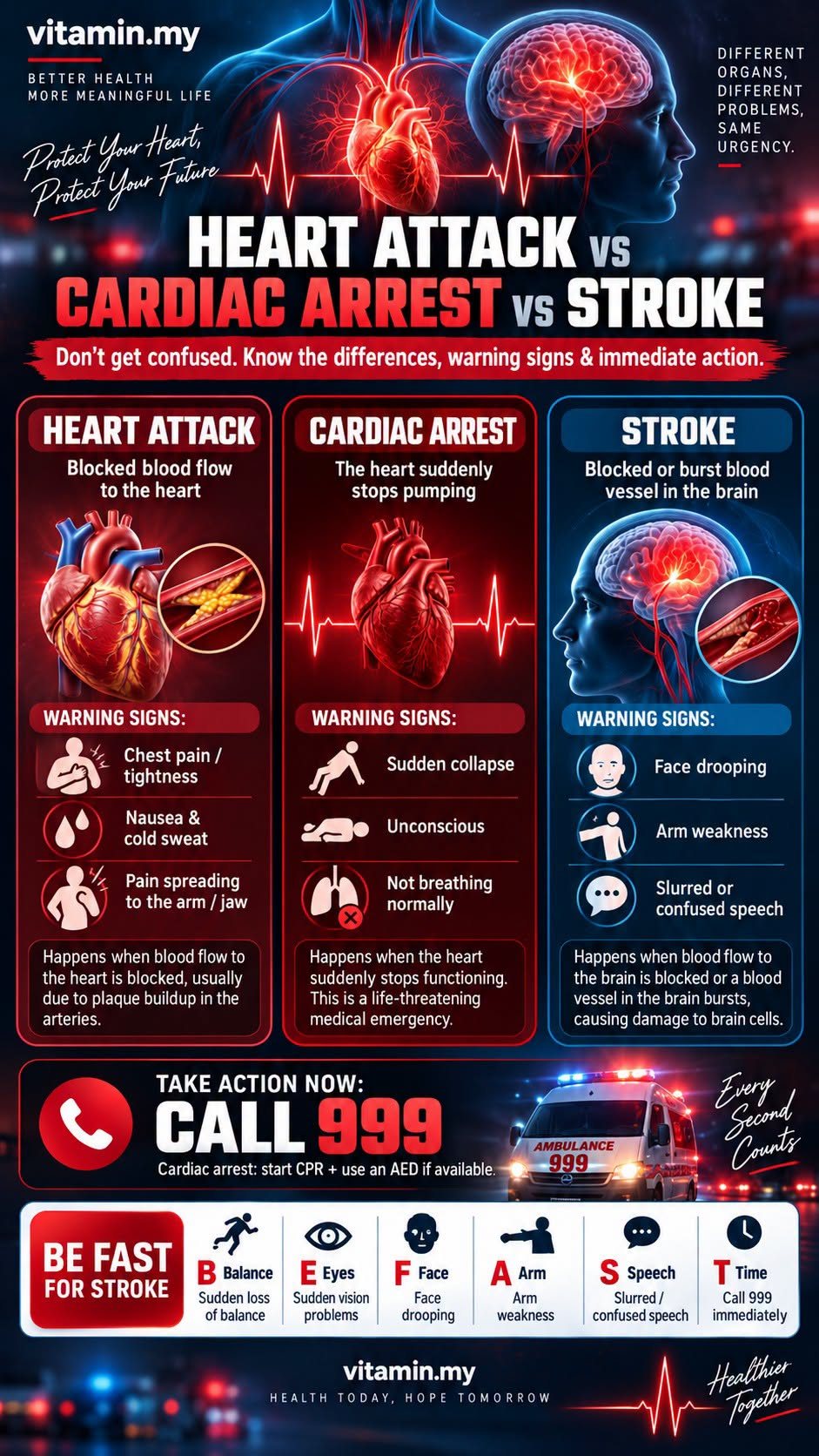
Heart Attack vs Cardiac Arrest vs Stroke: Know the Difference, Warning Signs and How to Reduce Your Risk
Meta Description: Heart attack, cardiac arrest and stroke are not the same medical emergency. Learn the key differences, warning signs, what to do immediately, Malaysian health statistics, risk factors and evidence-based ways to reduce your risk.
A person suddenly clutches their chest.
Another person collapses without warning.
Someone else suddenly cannot speak properly and one side of their face begins to droop.
People around them may describe all three situations as a “heart attack”. But medically, these could represent three very different emergencies: a heart attack, cardiac arrest or stroke.
The difference is not merely academic.
Knowing what is happening determines what you should do in the next few minutes — and those few minutes may determine whether the person survives and how much permanent damage occurs.
A heart attack is primarily a blood-flow problem involving the heart.
A cardiac arrest is primarily an electrical and pumping failure of the heart.
A stroke is primarily a blood-flow or bleeding problem involving the brain.
They can be related, they share many risk factors, and one condition can sometimes trigger another. But they are not interchangeable.
In Malaysia, understanding these conditions is increasingly important. Department of Statistics Malaysia data for deaths occurring in 2024 showed that ischaemic heart disease was once again the leading cause of medically certified deaths, accounting for 17,421 deaths or 13.0%.
Meanwhile, the National Health and Morbidity Survey 2023 found that among Malaysian adults, approximately 29.2% had hypertension, 33.3% had hypercholesterolaemia, 15.6% had diabetes, and 54.4% were overweight or obese. These are major cardiovascular risk factors.
So let us separate the three emergencies clearly.
Heart Attack vs Cardiac Arrest vs Stroke: The Simplest Explanation
| Condition | Main Problem | Organ Affected | Typical Situation |
|---|---|---|---|
| Heart Attack | Blood flow becomes blocked | Heart muscle | Usually conscious, chest discomfort, breathlessness |
| Cardiac Arrest | Heart suddenly stops pumping effectively | Heart, then whole body | Sudden collapse, unresponsive, not breathing normally |
| Stroke | Blood flow to brain blocked or blood vessel ruptures | Brain | Facial weakness, arm weakness, speech or balance problems |
A useful way to remember the difference is:
Heart attack = circulation problem in the heart.
Cardiac arrest = electrical/pumping problem in the heart.
Stroke = circulation or bleeding problem in the brain.
The American Heart Association emphasises that heart attack and cardiac arrest are different conditions. During a heart attack, blood supply to part of the heart becomes blocked, whereas during cardiac arrest the heart suddenly stops pumping effectively.
1. What Is a Heart Attack?
The medical term for a heart attack is myocardial infarction.
The heart is a muscle and, like every muscle in the body, it requires oxygen.
Oxygen reaches the heart muscle through blood vessels known as the coronary arteries.
Over many years, fatty deposits, cholesterol and other substances can accumulate in the walls of these arteries. This process is known as atherosclerosis.
Sometimes a plaque becomes unstable and ruptures.
The body interprets the rupture as an injury and forms a blood clot around it. Unfortunately, the clot may partially or completely block the coronary artery.
When blood flow is severely reduced or stopped, part of the heart muscle becomes deprived of oxygen.
If circulation is not restored quickly enough, heart-muscle cells begin to become injured and die.
That is a heart attack.
The heart usually continues beating during a heart attack. This is an important distinction from cardiac arrest.
A heart attack may, however, destabilise the heart’s electrical system and subsequently trigger a cardiac arrest.
What Does a Heart Attack Feel Like?
The classic symptom is discomfort in the centre of the chest.
But real heart attacks do not always look like dramatic television scenes where someone suddenly grabs their chest and falls to the floor.
Symptoms may develop gradually.
Common warning signs include:
- Pressure, tightness, squeezing, heaviness or pain in the chest
- Pain or discomfort spreading into one or both arms
- Pain in the shoulder, back, neck or jaw
- Shortness of breath
- Cold sweating
- Nausea or vomiting
- Light-headedness
- Sudden unexplained weakness or fatigue
The American Heart Association notes that symptoms can be intense and sudden, but they may also begin slowly and be relatively mild.
This is one reason people sometimes delay going to hospital.
They tell themselves:
“It is probably gastric.”
“Maybe I slept badly.”
“Perhaps I pulled a muscle.”
“I’ll wait another hour.”
That delay can be dangerous.
Heart Attack Symptoms Are Not Identical in Everyone
Chest discomfort remains an important warning sign, but not everyone experiences exactly the same pattern.
Women, older adults and people with diabetes may sometimes have less obvious symptoms.
For example, there may be:
- unusual fatigue,
- nausea,
- breathlessness,
- dizziness,
- back discomfort,
- jaw discomfort,
- or vague upper-body discomfort.
A person can also experience relatively mild symptoms despite having significant heart damage.
So the absence of dramatic crushing chest pain does not automatically rule out a heart attack.
2. What Is Cardiac Arrest?
Cardiac arrest is different.
During cardiac arrest, the heart suddenly becomes unable to pump enough blood to the brain and other vital organs.
This commonly occurs because the electrical activity controlling the heartbeat becomes severely abnormal.
One important rhythm is ventricular fibrillation, where the lower chambers of the heart quiver chaotically instead of producing an effective pumping action.
Within seconds, blood flow to the brain falls dramatically.
The person may:
- suddenly collapse,
- become unresponsive,
- stop breathing normally,
- or make occasional abnormal gasping movements.
Without immediate intervention, cardiac arrest can lead to death within minutes.
The American Heart Association describes cardiac arrest as an electrical problem rather than simply a blocked-artery problem.
What Does Cardiac Arrest Look Like?
Think:
Collapse + unresponsive + not breathing normally.
That combination should immediately raise suspicion of cardiac arrest.
Do not spend several minutes trying to decide whether the person has “fainted”.
Do not wait for them to wake up.
Do not rely on the presence of occasional gasping.
Agonal gasping can occur during cardiac arrest and is not normal breathing.
For members of the public, checking for a pulse can also waste valuable time and may be unreliable. If an adult or teenager suddenly collapses, is unresponsive and is not breathing normally, emergency action should begin.
3. What Should You Do During Cardiac Arrest?
In Malaysia, call 999, the national emergency number. Malaysia’s MERS 999 system connects emergency calls with agencies including the Ministry of Health Malaysia.
If the person is unresponsive and not breathing normally:
1. Call 999 or ask someone nearby to call.
2. Start chest compressions immediately.
Place both hands in the centre of the chest and push hard and fast.
For an average adult, current CPR guidance recommends approximately 100–120 compressions per minute, with a compression depth of around 5 cm, while allowing the chest to recoil between compressions.
3. Get an AED if one is available.
AED stands for Automated External Defibrillator.
You may see them in airports, sports facilities, office buildings, universities, shopping centres or other public locations.
Switch it on and follow its spoken instructions.
An AED analyses the heart rhythm and will deliver a shock only when an appropriate shockable rhythm is detected.
Continue CPR until the person begins showing clear signs of life or trained emergency personnel take over.
Immediate CPR is critical because chest compressions help maintain some blood flow to the brain and vital organs while waiting for definitive treatment.
4. Is Cardiac Arrest the Same as a Heart Attack?
No.
But they can be connected.
Imagine a coronary artery suddenly becomes blocked.
That is a heart attack.
The oxygen-starved heart muscle then becomes electrically unstable and develops a lethal arrhythmia.
The heart stops pumping.
Now the person has developed cardiac arrest.
Therefore:
A heart attack can cause cardiac arrest, but a heart attack is not automatically cardiac arrest.
Most people having a heart attack do not instantly lose consciousness. They may still be awake, talking and breathing.
Someone in cardiac arrest, by contrast, rapidly becomes unresponsive because circulation to the brain has stopped.
This distinction changes the emergency response.
Someone with suspected heart attack needs urgent ambulance and hospital treatment.
Someone in cardiac arrest needs CPR and an AED immediately, in addition to emergency medical help.
5. What Is a Stroke?
A stroke affects the brain, not primarily the heart.
Brain cells require a continuous supply of oxygen and glucose.
If blood supply to an area of the brain is suddenly interrupted, brain cells begin to malfunction.
There are two major categories.
Ischaemic Stroke
An ischaemic stroke occurs when an artery supplying the brain becomes blocked, usually by a blood clot.
It is conceptually similar to a heart attack, except the affected organ is the brain instead of the heart.
Haemorrhagic Stroke
A haemorrhagic stroke occurs when a blood vessel ruptures and bleeding occurs in or around the brain.
The treatment for these two types can be very different.
This is why someone with suspected stroke needs urgent brain imaging such as a CT scan or other appropriate hospital assessment before doctors determine the treatment.
6. Remember Stroke Symptoms With B.E. F.A.S.T.
Many people already know FAST, but BE FAST captures additional warning signs.
B — Balance
Has the person suddenly become dizzy, unstable or unable to coordinate their walking?
E — Eyes
Has vision suddenly become blurred, doubled or lost?
F — Face
Ask the person to smile.
Does one side of the face droop?
A — Arms
Ask the person to raise both arms.
Does one arm drift downward or feel suddenly weak or numb?
S — Speech
Is the person’s speech slurred?
Are they using strange words?
Can they understand what you are saying?
T — Time
Do not wait.
Call 999 immediately.
Other possible stroke symptoms include sudden numbness on one side of the body, sudden confusion, severe unexplained headache, sudden difficulty walking or sudden loss of coordination.
Even if the symptoms disappear after several minutes, emergency medical evaluation is still necessary.
7. What Is a TIA?
Sometimes stroke-like symptoms appear temporarily and then disappear.
This may be a transient ischaemic attack, commonly called a TIA.
Some people describe it as a “mini-stroke”, but the word “mini” can create the wrong impression.
A TIA should not be treated casually.
Temporary symptoms can be an important warning that blood flow to part of the brain was interrupted and that a future stroke may occur.
If the face suddenly droops, an arm becomes weak or speech becomes abnormal — even if everything returns to normal shortly afterwards — medical assessment is still urgent.
Do not simply go home because the symptoms disappeared.
8. Heart Attack, Cardiac Arrest and Stroke: What Should You Do?
This is perhaps the most important section of the entire article.
If You Suspect a Heart Attack
Call 999.
Keep the person at rest and avoid unnecessary exertion.
Do not ask them to drive themselves to hospital.
Do not waste time trying multiple home remedies to see whether the pain disappears.
Emergency medical personnel can assess the patient and begin appropriate treatment while arranging transport.
If aspirin is being considered, follow instructions from emergency medical personnel or a healthcare professional because aspirin is not appropriate for every person or every type of medical emergency.
If You Suspect Cardiac Arrest
Call 999.
Start CPR.
Get an AED.
Do not simply place the person in a car and begin driving to hospital while nobody is performing CPR.
The immediate problem is that the brain and organs are not receiving adequate circulation.
CPR and early defibrillation can be lifesaving.
If You Suspect a Stroke
Call 999 immediately.
Note the time the person was last known to be normal.
Do not give food or drinks because swallowing may be impaired.
Do not automatically give aspirin because some strokes involve bleeding, and aspirin can worsen bleeding.
Hospital assessment and brain imaging are required to determine the type of stroke and appropriate treatment.
9. Why Does Time Matter So Much?
All three conditions are time-sensitive.
During a heart attack, prolonged loss of blood supply causes increasing heart-muscle damage.
During a stroke, prolonged interruption of blood flow can result in increasing brain injury.
During cardiac arrest, circulation to the brain falls dramatically within seconds.
This is why medical teams often emphasise:
Time is muscle in heart attack.
Time is brain in stroke.
And during cardiac arrest, every minute without effective circulation matters.
The correct response is therefore not:
“Let’s wait and see.”
It is:
“Recognise the warning signs and activate emergency care.”
10. The Malaysian Cardiovascular Problem Is Bigger Than One Disease
Malaysia faces a large burden of metabolic and cardiovascular risk.
NHMS 2023 reported:
- 15.6% prevalence of diabetes among adults
- 29.2% prevalence of hypertension
- 33.3% prevalence of high cholesterol
- 54.4% prevalence of overweight and obesity
- 54.5% prevalence of abdominal obesity
- 29.9% of adults physically inactive
- only 4.9% consuming adequate fruit and vegetables
It also found that some people with diabetes, hypertension or high cholesterol did not know they had the condition.
That is important because high blood pressure and high cholesterol often cause no obvious symptoms.
A person can feel completely normal while vascular damage develops slowly over many years.
Then the first obvious sign may be a heart attack or stroke.
11. Shared Risk Factors
Heart attack and stroke share many of the same underlying risk factors.
Cardiac arrest also overlaps with them because coronary heart disease can trigger dangerous arrhythmias.
Major modifiable risk factors include:
- High blood pressure
- High LDL cholesterol
- Diabetes
- Smoking
- Obesity, particularly abdominal obesity
- Physical inactivity
- Unhealthy dietary patterns
- Excessive sodium intake
- Excessive alcohol consumption
- Poor management of existing cardiovascular disease
Other factors cannot be changed, including increasing age, family history and certain genetic conditions.
Some people can also develop cardiac arrest because of inherited electrical disorders, cardiomyopathy, congenital abnormalities or other heart conditions.
Therefore, eating a healthy diet cannot guarantee that a person will “never have cardiac arrest”.
Rather, healthy lifestyle habits reduce several important cardiovascular risks and may reduce the likelihood of coronary disease, heart attack and stroke.
WHO identifies unhealthy diet, physical inactivity and tobacco use among major behavioural cardiovascular risk factors, which then contribute to high blood pressure, high glucose, abnormal blood lipids and obesity.
12. What Is the Best Diet for the Heart and Brain?
There is no single magical food that cleans arteries or guarantees protection from stroke.
The strongest evidence supports an overall dietary pattern.
A heart-healthy eating pattern generally emphasises:
- Vegetables
- Fruits
- Whole grains
- Beans and legumes
- Nuts and seeds
- Fish
- Appropriate portions of lean protein
- Minimally processed foods
- Unsaturated fats
- Water and unsweetened drinks
And limits:
- Sugary beverages
- Excess salt
- Highly processed foods
- Processed meats
- Excess saturated fat
- Refined carbohydrates
- Frequent large portions of energy-dense foods
The American Heart Association’s 2026 guidance continues to emphasise the overall dietary pattern rather than relying on isolated “superfoods”.
13. Mediterranean-Style Eating
The Mediterranean diet is one of the most extensively studied cardiovascular eating patterns.
It typically emphasises:
- vegetables,
- fruits,
- legumes,
- whole grains,
- nuts,
- seeds,
- fish,
- and unsaturated fats such as olive oil.
It generally contains less processed meat, refined carbohydrates and heavily processed foods.
Importantly, you do not have to eat European food to apply Mediterranean principles.
The principle can be adapted to Malaysian meals.
For example:
Instead of: fried chicken + white rice + sweet drink
Try: grilled fish + moderate rice portion + ulam or mixed vegetables + plain water.
Instead of: processed sausage every morning
Try: eggs, dhal, tempeh or other minimally processed protein sources.
Instead of: sweetened tea several times per day
Try: gradually reduce the sugar or choose unsweetened beverages.
The 2024 American Heart Association/American Stroke Association primary stroke-prevention guideline supports a Mediterranean dietary pattern as one approach to lowering stroke risk.
14. What About the DASH Diet?
DASH stands for Dietary Approaches to Stop Hypertension.
It was developed with blood-pressure reduction in mind.
The pattern generally encourages:
- vegetables,
- fruits,
- whole grains,
- legumes,
- nuts,
- lower-fat dairy where appropriate,
- lean proteins,
- and lower sodium intake.
This is highly relevant because blood pressure is one of the most important modifiable risk factors for stroke and cardiovascular disease.
A person does not need to follow DASH perfectly to benefit from its principles.
Simply increasing plant foods while reducing sodium-heavy processed foods can be a meaningful start.
15. Salt: The Risk Factor Hiding in Everyday Food
Many people think reducing sodium only means putting less salt into the cooking pot.
But sodium can come from many other sources:
- soy sauce,
- seasoning powders,
- stock cubes,
- processed meat,
- instant noodles,
- sauces,
- packaged snacks,
- preserved foods,
- restaurant meals.
WHO recommends adults keep salt intake below approximately 5 grams per day, equivalent to about 2 grams of sodium. High sodium intake contributes to elevated blood pressure, which in turn increases cardiovascular and stroke risk.
You do not need to make food tasteless.
Flavour can also come from:
- garlic,
- ginger,
- chilli,
- lime,
- lemon,
- onions,
- herbs,
- spices,
- turmeric,
- black pepper.
The goal is not to fear salt.
The goal is to stop consuming excessive sodium unknowingly.
16. Malaysian Food Does Not Have to Become “Western Diet Food”
Healthy eating does not mean surviving on salad.
A Malaysian plate can be heart-friendly.
Breakfast
Instead of frequently combining roti canai, processed meat and sweet teh tarik, rotate options such as:
- oats with nuts and fruit,
- wholegrain bread with egg,
- chapati with dhal,
- yoghurt with fruit where appropriate,
- or traditional meals with better portion control and less sugar.
Lunch
Aim for:
- plenty of vegetables,
- adequate protein,
- a sensible portion of rice or another carbohydrate,
- fewer deep-fried dishes,
- and less gravy loaded with salt, sugar and saturated fat.
Dinner
The same principle applies.
The issue is rarely one specific traditional food.
The larger problem is the overall pattern — oversized portions, frequent sugary drinks, insufficient vegetables, excessive processed food, excessive sodium and too little movement.
17. Is Fat Always Bad?
No.
The old idea that every type of dietary fat is equally harmful is too simplistic.
The type of fat matters.
Foods containing predominantly unsaturated fats — such as nuts, seeds, fish and suitable plant oils — can form part of a healthy cardiovascular eating pattern.
Meanwhile, dietary patterns high in saturated fat, processed meat and industrially produced trans fats should be limited.
The goal is not a “zero-fat diet”.
It is a better-fat diet within an appropriate overall energy intake.
18. What About Sugar?
Excess sugar does not usually block an artery overnight.
The problem develops through its long-term metabolic consequences.
Frequent excess intake of sugary drinks and highly refined foods can contribute to:
- excessive calorie intake,
- weight gain,
- insulin resistance,
- type 2 diabetes,
- high triglycerides,
- fatty liver,
- and worsening metabolic health.
Those conditions increase cardiovascular risk over time.
A simple change such as replacing sweet drinks with plain water most days can significantly improve the overall quality of a person’s diet without requiring an extreme eating plan.
19. Exercise Is Part of Cardiovascular Medicine Too
Food is only one part of prevention.
Regular movement improves cardiovascular fitness and helps with blood pressure, insulin sensitivity, weight management and overall metabolic health.
WHO recommends most adults aim for approximately 150–300 minutes of moderate-intensity aerobic activity per week, or 75–150 minutes of vigorous activity, together with muscle-strengthening activities on at least two days each week.
That does not mean everyone needs to become a marathon runner.
Walking counts.
Cycling counts.
Swimming counts.
Household and recreational activity counts.
If someone has been inactive for years or already has heart disease, significant symptoms or major medical conditions, the exercise plan should be adjusted appropriately with healthcare advice.
20. Do Not Ignore Smoking
Smoking damages blood vessels, promotes atherosclerosis and increases cardiovascular risk.
It is not enough to eat oats, take supplements and walk every evening while continuing to smoke heavily.
Cardiovascular health depends on the overall picture.
For smokers, stopping tobacco use is among the most important modifiable steps for reducing cardiovascular risk.
21. Know Your Numbers Before Symptoms Appear
One of the biggest mistakes is waiting until the body feels sick before checking cardiovascular risk.
You should know your:
- Blood pressure
- Blood glucose
- Cholesterol profile
- Body weight
- Waist circumference
- Smoking status
- Physical activity level
Depending on age, family history and existing disease, a healthcare professional may recommend additional assessment.
Why is screening important?
Because hypertension may be silent.
High cholesterol is usually silent.
Early diabetes can also be silent.
Atherosclerosis itself may develop silently for years.
Prevention therefore begins before chest pain and before facial weakness appear.
22. Myth: “I’m Young, So It Can’t Be My Heart”
Age matters, but age is not a guarantee.
Younger adults can still develop hypertension, diabetes, severe obesity, inherited cholesterol problems, congenital heart conditions or dangerous arrhythmias.
NHMS 2023 also highlighted undiagnosed metabolic risk among younger Malaysians.
The lesson is not that every young person should be afraid.
The lesson is that prevention should start young rather than waiting until age 60.
23. Myth: “If I Exercise, I Can Eat Anything”
Exercise is powerful, but it does not erase every other risk factor.
Someone can exercise regularly and still have:
- very high LDL cholesterol,
- uncontrolled hypertension,
- diabetes,
- smoking-related vascular damage,
- or an unhealthy dietary pattern.
Likewise, someone can eat vegetables every day and remain very sedentary.
Cardiovascular prevention works best when several factors are improved together.
24. Myth: “Cardiac Arrest Means the Heart Has Completely Died”
Not necessarily.
Some cardiac arrests involve rhythms such as ventricular fibrillation that may respond to defibrillation.
This is exactly why rapid CPR and AED use are so important.
An AED does not magically restart every stopped heart.
Instead, it analyses the rhythm and determines whether an electrical shock is appropriate.
That is also why people should not be frightened to use one.
Turn it on and follow the instructions.
25. Myth: “If Stroke Symptoms Disappear, Everything Is Fine”
Wrong.
Temporary neurological symptoms may represent a TIA.
Even though the person appears normal again, they still require urgent medical evaluation.
A disappearing symptom is not permission to ignore what happened.
26. The Three Emergencies in One Sentence Each
If you remember nothing else from this article, remember these three sentences:
Heart Attack
The heart is usually still beating, but part of the heart muscle is losing blood supply.
Cardiac Arrest
The person has collapsed because the heart is no longer pumping blood effectively.
Stroke
Part of the brain has suddenly lost normal blood supply or is bleeding.
And in Malaysia:
Emergency = 999
Do not waste precious time debating which hospital to drive to or waiting for symptoms to become “serious enough”.
27. A Practical Cardiovascular Prevention Checklist
You cannot control every possible cause of heart attack, stroke or cardiac arrest.
But you can reduce many major risks.
Start with the basics:
Check your blood pressure.
If it is repeatedly high, get it assessed and treated.
Know your cholesterol.
Do not assume cholesterol is normal simply because you are thin.
Screen for diabetes.
Especially if you have obesity, family history or other risk factors.
Stop smoking.
Move regularly.
Aim toward recommended physical activity levels according to your ability and health status.
Eat more minimally processed foods.
Build meals around vegetables, fruits, legumes, whole grains, nuts, seeds, fish and other appropriate protein sources.
Reduce sugary drinks.
Reduce excessive sodium.
Maintain a healthy weight and waist circumference.
Take prescribed medicines consistently.
Lifestyle change does not mean stopping blood-pressure, cholesterol or diabetes medicines without medical supervision.
Conclusion: Three Different Emergencies, One Important Lesson
Heart attack, cardiac arrest and stroke may occur suddenly, but they are not the same disease.
A heart attack occurs when blood flow to part of the heart muscle becomes critically reduced or blocked.
A cardiac arrest occurs when the heart suddenly stops pumping blood effectively, often because of a dangerous electrical rhythm.
A stroke occurs when blood supply to part of the brain becomes blocked or when a brain blood vessel ruptures.
Their emergency responses differ.
Suspected heart attack?
Call 999.
Suspected stroke?
Call 999 immediately.
Someone suddenly collapses, is unresponsive and is not breathing normally?
Call 999, begin CPR and use an AED as soon as possible.
But there is another lesson.
Many of the conditions that increase our risk — high blood pressure, diabetes, high cholesterol, obesity, smoking, physical inactivity and poor dietary patterns — can develop silently.
Malaysia’s health statistics show that these risk factors are already widespread.
So cardiovascular prevention should not begin after a heart attack.
It should not begin after a stroke.
And it certainly should not begin after someone survives cardiac arrest.
It begins much earlier: with knowing your numbers, improving your diet, staying active, avoiding tobacco, managing existing medical conditions properly and recognising emergency warning signs when they appear.
You may never personally need to perform CPR.
You may never witness a stroke.
But learning these differences takes only a few minutes.
One day, those few minutes of knowledge could help save somebody’s life.
Medical Disclaimer: This article is intended for general health education and is not a substitute for diagnosis, treatment or personalised advice from a qualified healthcare professional. Chest pain, sudden neurological symptoms, collapse, loss of consciousness or abnormal breathing should be treated as medical emergencies.
