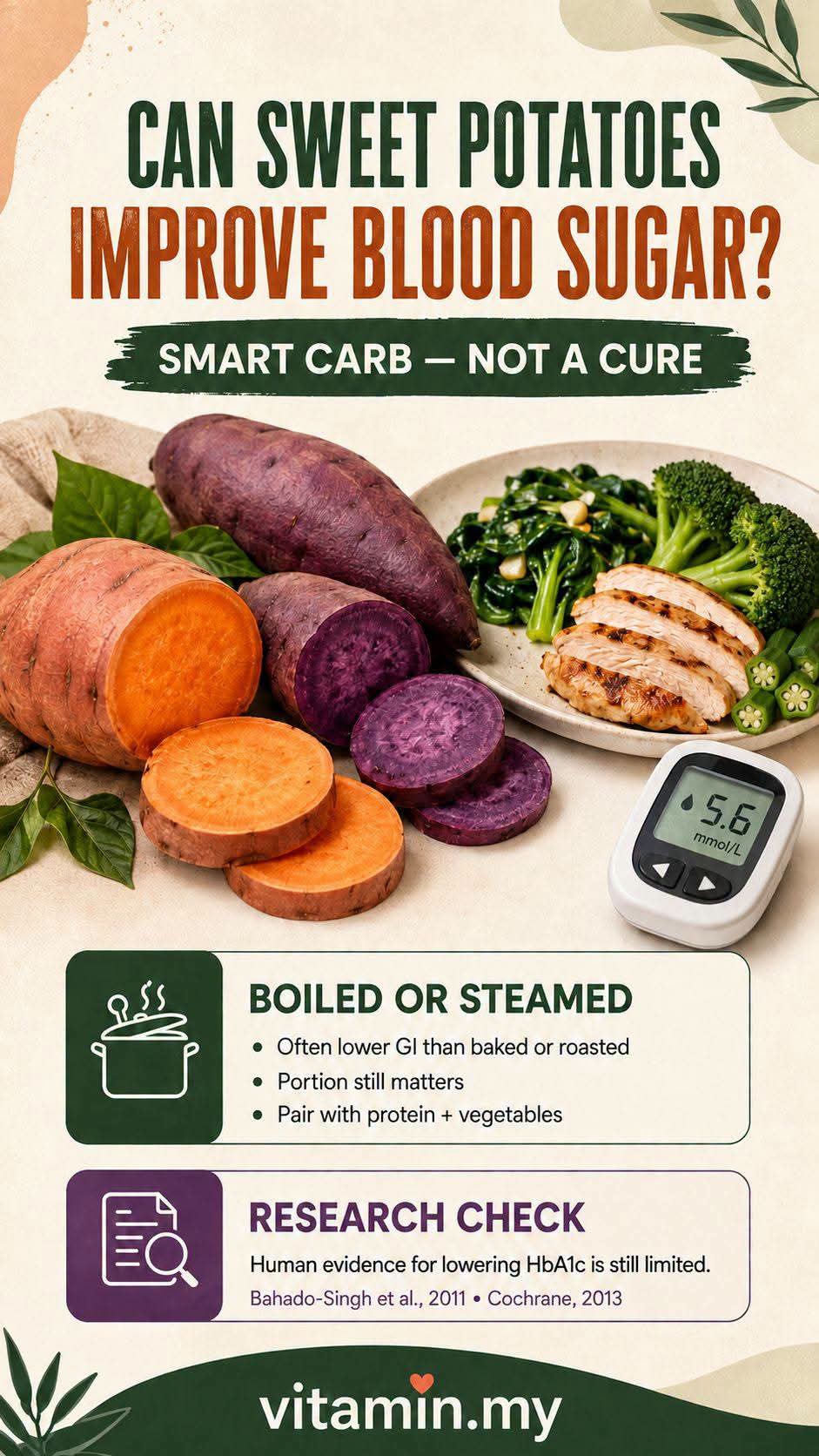
Sweet potatoes taste sweet and contain carbohydrate, so it is understandable that many people with diabetes assume they must avoid them. Others make the opposite claim: that sweet potatoes are a “superfood” capable of lowering glucose or reversing insulin resistance.
Neither extreme tells the whole story.
Sweet potatoes can be a nutritious carbohydrate choice. They provide fibre, carotenoids, potassium and several other micronutrients. Depending on the variety and preparation, they may produce a gentler glucose response than some refined carbohydrates.
However, they still contain digestible starch. A large serving can raise blood sugar, and eating sweet potato does not cancel the effects of an unbalanced diet, insufficient physical activity, inadequate sleep or inappropriate medication.
The scientifically honest answer is this: sweet potatoes may support better blood sugar management when the portion, preparation and overall meal are appropriate, but they are not a treatment for diabetes and are not guaranteed to lower glucose.
This article explains what happens after you eat sweet potato, what clinical research has—and has not—proved, which preparation methods are more glucose-friendly, and how to include this familiar food in a balanced meal.
Why a Sweet Food Is Not Automatically “Bad for Sugar”
The word “sweet” can be misleading. The metabolic effect of a food is not determined by taste alone. What matters includes the amount of available carbohydrate, the physical structure of the food, fibre, starch type, cooking method, portion size and the other foods eaten at the same meal.
A whole sweet potato is very different from a sweetened drink, biscuit or sweet-potato dessert.
A sugary drink may deliver rapidly absorbable sugar with almost no intact fibre. A whole tuber contains water, fibre and a cellular structure that takes time to break down. That difference can affect digestion, fullness and the speed at which glucose enters the bloodstream.
This does not make carbohydrate “free.” Most of the carbohydrate in sweet potato is starch, and digestive enzymes break much of that starch into glucose.
The useful question is therefore not, “Does sweet potato contain carbs?” It clearly does.
The better question is:
“How much am I eating, how was it prepared, and what is the quality of the entire meal?”
What Is Inside a Sweet Potato?
Nutrient content varies according to cultivar, size, growing conditions and preparation.
As a practical estimate, one medium cooked sweet potato may provide roughly:
- 110–140 calories
- 25–30 grams of carbohydrate
- Around 4 grams of fibre
- Potassium
- Vitamin C
- Vitamin B6
- Manganese
- Plant pigments and antioxidants
Orange-fleshed varieties are especially rich in beta-carotene, which the body can convert into vitamin A. Purple varieties contain anthocyanins, the pigments responsible for their deep colour.
The USDA FoodData Central database shows why serving size matters. Nutrient values may be reported per 100 grams, per cup or per individual item, and those portions are not interchangeable.
A small tuber and a very large restaurant portion can have very different carbohydrate loads.
Sweet potatoes are nutrient-dense, but “nutritious” does not mean “unlimited.” For someone monitoring glucose, the amount on the plate remains important.
Glycaemic Index Is Useful—but It Is Not the Whole Answer
The glycaemic index, or GI, ranks carbohydrate-containing foods according to how quickly they raise blood glucose under standard testing conditions.
A GI of 55 or below is generally classed as low, 56–69 as medium and 70 or above as high.
GI is often treated as a fixed identity. People hear that sweet potato is “low GI” and assume every sweet potato recipe will have the same effect.
In reality, GI can change considerably with:
- Sweet-potato variety
- Ripeness
- Processing
- Cooking method
- Cooking time
- Food texture
- Serving temperature
Researchers who tested ten Caribbean sweet-potato preparations found substantial differences according to both variety and cooking method. Boiling generally produced lower GI values than roasting or baking, although not every variety behaved identically.
The study is an important reminder that there is no single universal GI number for all sweet potatoes. The research was published in the Journal of Nutrition and Metabolism.
Glycaemic load, or GL, adds another essential piece: portion size.
A food may have a moderate or high GI but produce a smaller total glucose exposure when eaten in a modest amount. Conversely, a very large serving of a lower-GI food can still deliver a substantial carbohydrate load.
GI also tests a food in isolation. Most people do not eat plain sweet potato after an overnight fast.
They eat it with fish, chicken, tofu, tempeh, eggs, vegetables, curry, coconut milk, butter, sugar or oil. Those additions can change gastric emptying, energy density and the overall glucose response.
Cooking Method Can Change the Glucose Response
How sweet potato is cooked changes the structure and availability of its starch.
Boiled sweet potato
Boiling is often the most practical option for glucose management.
In the processing study mentioned earlier, boiled preparations generally had a lower GI than baked or roasted versions. Boiling in water limits the intense dry heat that can make starch easier to digest and may produce a less concentrated food by weight.
That does not mean boiled sweet potato cannot raise glucose. Portion size still matters, and different varieties can behave differently.
Nevertheless, plain boiled sweet potato is usually a more sensible starting point than fries, crisps or a sweetened dessert.
Steamed sweet potato
Steaming can also be a useful low-fat preparation because it requires no added oil. Its precise effect on GI varies with variety and cooking time.
A very soft, thoroughly gelatinised tuber may be digested more quickly than one cooked until just tender.
A 2026 experiment found that steamed—and especially cooked, chilled and steamed again—yellow sweet potato improved several metabolic markers in obese rats. The twice-processed version contained more resistant starch.
This is interesting mechanistic evidence, but it remains an animal study. It cannot prove that the same preparation will lower HbA1c in people.
The research is available in Discover Food.
Baked or roasted sweet potato
Baking and roasting can produce a surprisingly high GI in some sweet-potato varieties.
Dry heat, prolonged cooking and disruption of the starch structure may make carbohydrate more accessible to digestive enzymes. Roasting also concentrates flavour, making it easy to eat a larger amount.
Baked sweet potato is not forbidden. It simply should not receive an automatic health halo.
Keep the serving moderate and build the rest of the plate around non-starchy vegetables and a suitable protein source.
Fried or heavily processed sweet potato
Sweet-potato fries are still fries.
Frying adds calories and often sodium, while commercial coatings and sauces may add refined flour or sugar. Fat can sometimes slow the immediate glucose rise, but that does not transform a deep-fried food into the best choice for long-term cardiometabolic health.
Sweet-potato chips, sweetened purées, kuih, doughnuts, bubble-tea toppings and desserts should not be considered equivalent to a plain cooked tuber.
The name of the main ingredient does not tell you the nutritional quality of the finished food.
Cooked, cooled and reheated sweet potato
When some cooked starches cool, part of the starch rearranges into a form that resists digestion in the small intestine.
This process is called retrogradation, and the resulting resistant starch may reduce the glucose response in certain foods.
However, the effect is not guaranteed to be large. Most direct human evidence concerns ordinary potatoes, rice or pasta rather than every sweet-potato variety.
Cooling is a possible optimisation—not permission to ignore portion size.
Always refrigerate cooked sweet potatoes promptly and reheat them safely if you plan to use this approach.
Does Sweet Potato Actually Lower Blood Sugar?
This is where marketing claims often run ahead of the evidence.
Several small clinical trials investigated Caiapo, a preparation made from white-skinned sweet potato, in people with type 2 diabetes.
A randomised study reported improvements in glucose control and cholesterol after Caiapo supplementation. Another investigation suggested improved insulin sensitivity.
These findings are the origin of many claims that sweet potato is “anti-diabetic.” The relevant trials can be found through PubMed and Diabetes Care.
But there are major limitations.
First, a standardised tablet or extract is not the same intervention as eating a serving of orange sweet potato at dinner.
Second, the studies were small and came from the same research group.
Third, short-term changes in biomarkers do not prove prevention of complications such as kidney disease, cardiovascular events, vision loss or neuropathy.
A Cochrane review pooled three randomised trials involving only 140 participants.
Two trials using 4 grams per day of the sweet-potato preparation found an average HbA1c reduction of about 0.3 percentage points over three to five months.
However, the reviewers judged the evidence to be of very low quality and concluded that it was insufficient to recommend sweet potato as a diabetes treatment.
The trials did not establish effects on:
- Diabetic complications
- Quality of life
- Mortality
- Functional outcomes
- Healthcare costs
The full conclusion is available in the Cochrane evidence summary.
Therefore, it would be inaccurate to promise that eating an ordinary sweet potato will lower fasting glucose or HbA1c.
The stronger and more defensible claim is that a sensibly prepared sweet potato can fit into an eating pattern designed for glucose management.
How Sweet Potatoes May Support Better Glucose Management
Although sweet potatoes are not medicine, they have several features that may be useful.
1. Fibre slows the meal down
Fibre is not fully digested into glucose. It adds bulk, supports bowel health and can increase fullness.
In a mixed meal, fibre-rich foods may slow the overall rate of digestion compared with refined, low-fibre carbohydrates.
The effect should not be exaggerated. A few grams of fibre cannot neutralise an oversized carbohydrate portion.
Still, choosing a whole tuber—especially with its edible skin when appropriate—usually preserves more structure and fibre than consuming a smooth, sweetened purée.
2. Resistant starch may reduce rapid digestion
Resistant starch escapes digestion in the small intestine and reaches the colon, where gut microbes can ferment it into short-chain fatty acids.
Research is exploring how these metabolites may influence gut health and metabolic regulation.
The amount of resistant starch in a sweet potato depends on its variety and preparation. Human outcome data remain limited, so this mechanism should be described as plausible rather than proven therapy.
3. Colourful varieties provide plant compounds
Orange sweet potatoes contain carotenoids, while purple varieties are rich in anthocyanins and other phenolic compounds.
Laboratory and animal studies suggest antioxidant, anti-inflammatory and glucose-related effects through several pathways, including digestive enzymes, glucose transport and cellular signalling.
A 2025 scientific review summarised growing interest in sweet-potato anthocyanins, but much of the evidence remains preclinical or based on extracts rather than ordinary portions of whole food.
The review is indexed on PubMed.
These compounds add nutritional value. They do not justify calling purple sweet potato a cure for diabetes.
4. Sweet potato may replace a less useful food
The benefit of a food often depends on what it replaces.
A moderate portion of boiled sweet potato replacing a large plate of refined rice, sugary cereal, pastries or fried snacks may improve meal quality.
Adding sweet potato on top of the same meal simply adds more carbohydrate and calories.
Substitution is one of the most overlooked ideas in nutrition. Ask, “What am I eating instead?” rather than judging the sweet potato in isolation.
5. It can make a balanced diet easier to maintain
Sweet potato is affordable, filling, widely available and familiar in Malaysia.
An eating plan that uses enjoyable local foods may be easier to maintain than a highly restrictive diet. Long-term consistency matters more than chasing a supposedly perfect ingredient for a few days.
Orange, Purple or White: Which Is Best?
No colour wins in every category.
Orange-fleshed sweet potatoes
Orange varieties are rich in beta-carotene and can contribute significantly to vitamin A intake. Their glucose effect still depends on cultivar, preparation and portion.
Purple sweet potatoes
Purple varieties provide anthocyanins and other polyphenols. Their colour signals a different phytochemical profile, but purple does not automatically mean low GI.
White or cream-fleshed sweet potatoes
White varieties may have a different balance of starch, fibre and phenolic compounds.
Caiapo research used a specific white-skinned variety and preparation. Its findings cannot be transferred automatically to every white sweet potato sold in a market.
The practical priority is not choosing a fashionable colour.
It is finding a minimally processed variety you enjoy, cooking it sensibly, controlling the portion and checking your individual glucose response.
A Better Way to Put Sweet Potato on the Plate
For a simple meal template, use approximately:
- Half the plate: Non-starchy vegetables such as sawi, kailan, cabbage, cucumber, okra, broccoli, long beans or salad.
- One quarter: Protein such as fish, skinless chicken, eggs, tofu, tempeh or legumes, adjusted for individual needs.
- One quarter: A carbohydrate such as boiled sweet potato.
For many adults, about half a cup of cooked cubes or one small sweet potato is a reasonable amount to test, but there is no universal serving.
Body size, medications, physical activity, glucose targets and the carbohydrate content of the rest of the meal all matter.
Avoid combining several large starches by accident.
A meal containing sweet potato, rice, noodles, bread and a sweet drink is not simply a “sweet-potato meal.” It is a high-carbohydrate meal.
Pairing the tuber with protein and non-starchy vegetables generally creates a more balanced plate. Eat slowly and stop at comfortable fullness.
Plain water, unsweetened tea or coffee is a more sensible drink than juice or syrup.
Three Mistakes That Can Keep Glucose High
Mistake 1: Treating a healthy carbohydrate as an unlimited food
People sometimes replace rice with sweet potato but eat two or three large tubers because the new food feels healthier.
Total carbohydrate may then remain high—or increase.
Measure the serving at least once so that your visual estimate is realistic.
Mistake 2: Ignoring the recipe
Sweet potato cooked with condensed milk, brown sugar, syrup, marshmallows or a thick sweet sauce is no longer comparable with plain boiled sweet potato.
“Natural” sweeteners such as honey, date syrup and coconut sugar still contribute sugar.
Mistake 3: Expecting one food to repair the entire lifestyle
Blood glucose reflects more than the previous meal.
Medication, sleep, stress, illness, menstrual changes, physical activity, alcohol, hydration and overall energy balance can all influence glucose readings.
Sweet potato cannot compensate for every other factor.
Blood-Sugar-Conscious Scalloped Sweet Potatoes
Traditional scalloped potatoes can be heavy in cream, butter and cheese. This lighter version keeps the comforting texture while adding mushrooms and herbs.
It is still a carbohydrate-containing side dish, so serve a modest portion with protein and vegetables.
Ingredients—serves six as a side
- 600 grams sweet potato, scrubbed and thinly sliced
- 200 grams mushrooms, sliced
- 1 small onion, thinly sliced
- 2 cloves garlic, minced
- 1 tablespoon olive oil
- 250 millilitres unsweetened low-fat milk or unsweetened soy milk
- 1 tablespoon wholemeal flour, optional
- 1 teaspoon dried thyme or mixed herbs
- Black pepper to taste
- A small pinch of salt, if appropriate
- 30 grams grated cheese, optional
- Chopped parsley or spring onion
Method
- Heat the oven to 190°C and lightly oil a baking dish.
- Sauté the onion and mushrooms in olive oil until softened. Add the garlic and herbs.
- If using flour, stir it through the mushroom mixture. Add the milk gradually and simmer until slightly thickened.
- Arrange the sweet-potato slices in the dish and spoon the mushroom sauce between the layers.
- Cover and bake for approximately 30 minutes.
- Uncover, add the optional cheese and bake for another 15–20 minutes, or until tender.
- Rest for ten minutes before serving.
- Divide the dish into six portions instead of eating it as a main meal by itself.
For a potentially gentler glucose response, briefly boil the slices until partly tender before assembling, reduce the final baking time and omit sweetened sauces.
Individual glucose responses can still vary.
How to Test Your Own Response
Population averages are useful, but two people can respond differently to the same food.
If you monitor glucose, conduct a simple and consistent comparison.
Choose a portion and record your glucose before eating and at the time recommended by your clinician—often one or two hours after the start of the meal.
Repeat the meal on another day under similar conditions before drawing conclusions. A single reading can be affected by:
- Poor sleep
- Stress
- Recent exercise
- Illness
- Dehydration
- Meter variation
Change one variable at a time.
For example, compare boiled sweet potato with baked sweet potato while keeping the portion and accompanying foods similar. Alternatively, compare half a cup with one cup.
This gives more useful information than testing completely different meals.
Do not alter insulin or other medication simply because an online article describes a food as low GI.
People using insulin or medicines that can cause hypoglycaemia need an individual plan for carbohydrate intake, activity and dosing.
Who Needs Extra Caution?
People with diabetes can often eat sweet potato, but individual medical circumstances matter.
Insulin or sulfonylurea users
Carbohydrate intake should be coordinated with the treatment plan to reduce high or low glucose episodes.
People with chronic kidney disease
Sweet potatoes contain potassium. Some people with impaired kidney function are advised to limit potassium and require personalised guidance.
People with gastroparesis
Fibre and food texture may need adjustment because delayed stomach emptying changes both digestive symptoms and glucose timing.
Pregnancy or gestational diabetes
Carbohydrate requirements and glucose targets are specific during pregnancy. Follow the plan provided by the healthcare team.
People experiencing persistently high glucose
Food substitution alone may be insufficient. Medication review and medical assessment may be necessary.
Seek urgent medical attention for severe hyperglycaemia accompanied by vomiting, abdominal pain, deep or rapid breathing, confusion, marked drowsiness or signs of dehydration.
Frequently Asked Questions
Can people with diabetes eat sweet potatoes every day?
Possibly, if the serving fits their overall eating plan and their glucose response is acceptable.
Dietary variety is still valuable. Rotate sweet potatoes with legumes, intact whole grains and other nutrient-dense carbohydrate sources rather than relying on one food.
Is sweet potato better than white rice?
It can provide more fibre and micronutrients than refined white rice, but the result depends on portion and preparation.
Replacing a large rice serving with a modest amount of plain sweet potato may be useful. Eating a large sweet potato in addition to the usual rice is unlikely to help.
Is purple sweet potato the best for diabetes?
Purple varieties contain anthocyanins, but colour alone does not determine GI or a person’s glucose response.
Preparation and portion remain more immediately actionable.
Does sweet potato cure insulin resistance?
No.
Limited research on extracts and preclinical mechanisms does not establish a cure. Insulin resistance is influenced by genetics, body-fat distribution, physical activity, sleep, medication, health conditions and the overall dietary pattern.
Can I drink sweet-potato juice or smoothies instead?
Whole food is generally preferable because blending or juicing makes it easier to consume a large amount quickly.
Juice removes or disrupts much of the structure that contributes to fullness. If you use sweet potato in a smoothie, count it as a carbohydrate ingredient rather than a free vegetable.
The Bottom Line
Sweet potato is neither a forbidden food nor a glucose-lowering drug.
It is a nutritious starchy vegetable that can raise blood sugar, yet may fit well into a diabetes-conscious diet when it replaces a less nutritious carbohydrate and is eaten in a sensible portion.
Boiling or steaming is generally preferable to deep-frying or heavily sweetening it. Pair the sweet potato with non-starchy vegetables and protein, avoid stacking it with several other starches, and use your glucose readings to learn how your body responds.
The most important scientific correction is simple:
Evidence from small trials of a specific sweet-potato extract cannot prove that ordinary sweet potatoes treat diabetes.
The available research supports cautious inclusion, not miracle claims.
Your overall eating pattern, treatment plan and long-term habits matter far more than any single “superfood.”
This article is for general education and is not a substitute for diagnosis, medical nutrition therapy or personalised treatment from a doctor or registered dietitian.
References
- Original article: Sweet Potatoes Improve Blood Sugar?
- Ooi CP, Loke SC. Sweet potato for type 2 diabetes mellitus. Cochrane Database of Systematic Reviews. 2013.
- Bahado-Singh PS, et al. Relationship between processing method and the glycaemic indices of ten sweet potato cultivars commonly consumed in Jamaica. Journal of Nutrition and Metabolism. 2011.
- Ludvik B, et al. Efficacy of Ipomoea batatas (Caiapo) on diabetes control in type 2 diabetic subjects treated with diet. Diabetes Care. 2004.
- Maqsood S, et al. Anthocyanins from sweet potatoes (Ipomoea batatas). 2025.
- Kusuma HS, et al. Yellow sweet potato enhances insulin sensitivity and reduces type 2 diabetes risk in obese rats. Discover Food. 2026.
- USDA FoodData Central: Sweet potato.
