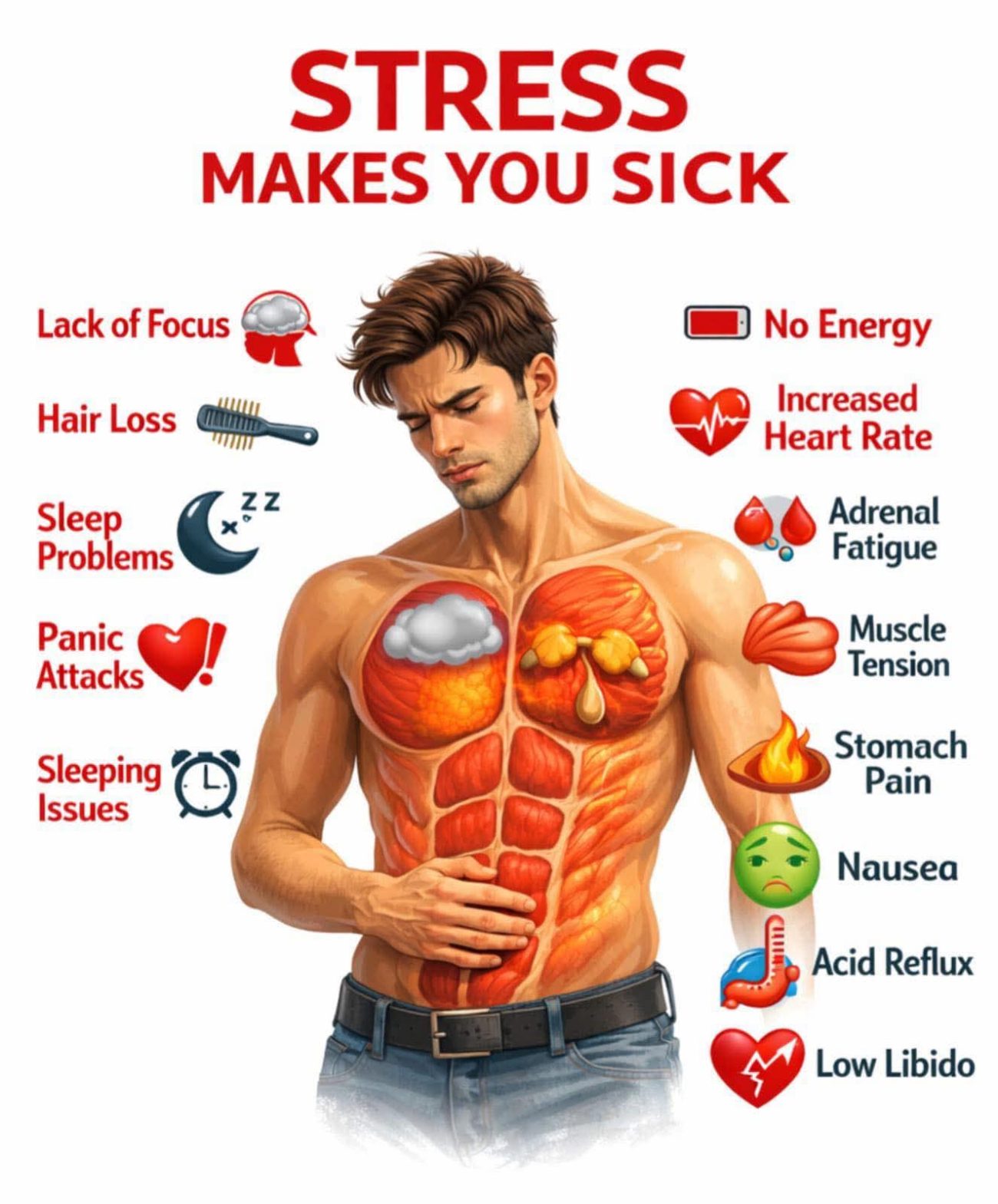
In today’s fast-moving world, stress has quietly become a universal experience. Deadlines at work, financial pressures, relationship struggles, and an always-on digital lifestyle have pushed millions of people into a state of constant tension — often without even realising it. What most people fail to understand, however, is that stress isn’t just a mental or emotional state. It’s a full-body event, and when left unchecked, it can silently dismantle your health from the inside out.
This isn’t a dramatic exaggeration. Scientific research consistently shows that chronic stress is directly linked to some of the most serious health conditions known today — from heart disease and diabetes to anxiety disorders and digestive problems. The damage is real, measurable, and unfortunately, often misdiagnosed or overlooked.
Let’s break down exactly what stress does to your body, system by system, and why it’s one of the most underrated health threats of our time.
WHAT ACTUALLY HAPPENS WHEN YOU’RE STRESSED?
Before we explore the symptoms, it’s important to understand the mechanism behind stress.
When your brain perceives a threat — whether it’s a looming deadline, a difficult conversation, or a financial crisis — it triggers what is known as the fight-or-flight response. Your body floods with stress hormones, primarily cortisol and adrenaline. Your heart rate spikes, muscles tighten, and your brain enters high-alert mode.
This system is brilliant when you’re facing a real, immediate danger. The problem is that in modern life, the “danger” never really goes away. Bills don’t stop coming. Work pressure doesn’t disappear. Social anxiety doesn’t switch off. And so the stress response — designed to be temporary — gets stuck in the “on” position.
This is what we call chronic stress, and it is here where the real damage begins.
1. YOUR BRAIN TAKES THE FIRST HIT
One of the earliest casualties of chronic stress is cognitive function. If you’ve been feeling mentally foggy, struggling to concentrate, or constantly forgetting things, stress may well be the culprit.
When cortisol levels remain elevated for extended periods, it begins to interfere with the hippocampus — the region of the brain responsible for memory formation and learning. Studies have shown that prolonged high cortisol can actually shrink the hippocampus over time, leading to noticeable memory impairment.
Beyond memory, stress overloads your prefrontal cortex — the area responsible for decision-making, focus, and executive thinking. This is why when you’re stressed, simple tasks feel overwhelming, and making even minor decisions can feel like climbing a mountain.
The result? Declining productivity, frequent errors, decision fatigue, and in severe cases, full-blown mental burnout. Many people in high-stress careers normalise these symptoms as “just part of the job” — but they are signals from your brain that something needs to change.
2. YOUR HAIR STARTS TO FALL OUT
This one surprises many people, but it’s well-documented: stress causes hair loss.
The condition is known as telogen effluvium, and it occurs when a significant psychological or physical stressor pushes large numbers of hair follicles into a resting phase prematurely. Rather than going through the normal growth cycle, the hair simply stops growing and eventually falls out — sometimes weeks or even months after the stressful event.
Signs include unusually heavy shedding during showers, noticeably thinning hair, and a gradual recession of the hairline. Many people blame their shampoo, water quality, or diet — but the root cause is often internal stress that has never been properly addressed.
The good news is that this type of hair loss is usually reversible once the underlying stress is managed. But it does underscore just how deeply psychological stress can manifest in physical, visible ways.
3. SLEEP BECOMES YOUR ENEMY
Sleep problems and stress have a complicated, mutually destructive relationship.
Stress makes it difficult to fall asleep. It keeps your mind running through worst-case scenarios, replaying conversations, and fixating on unresolved problems — all at 2 in the morning when you desperately need rest. It also causes frequent night waking and prevents the kind of deep, restorative sleep your body needs to repair itself.
But here’s the cruel irony: poor sleep makes stress worse. Sleep deprivation raises cortisol levels, reduces emotional regulation, and impairs your ability to cope with everyday challenges. It’s a vicious cycle that many people are unknowingly trapped in.
The long-term consequences are serious. Chronic sleep deprivation weakens the immune system, accelerates ageing, increases the risk of obesity, and is strongly associated with depression and anxiety. Yet sleep is so often sacrificed in the name of productivity — ironically, the very thing that sleep protects.
4. PANIC AND ANXIETY TAKE HOLD
When the body remains in a near-constant state of fight-or-flight, anxiety becomes the baseline. And for many people, stress eventually escalates into panic attacks.
A panic attack is not just “feeling nervous.” It is an acute episode of intense fear accompanied by physical symptoms: a racing heart, chest tightness, shortness of breath, dizziness, sweating, and an overwhelming sense of dread — sometimes even a fear of dying.
What makes panic attacks particularly distressing is that they can occur without an obvious trigger. The body has been running on high alert for so long that it can reach a tipping point seemingly out of nowhere.
Chronic stress is one of the most significant contributors to generalised anxiety disorder (GAD), a condition in which worry and fear become persistent, disproportionate, and difficult to control. If your stress is never properly released or managed, anxiety can become a permanent fixture in your daily life rather than an occasional visitor.
5. YOUR ENERGY COMPLETELY COLLAPSES
Persistent fatigue is one of the most common — and most misunderstood — symptoms of chronic stress.
You might be sleeping eight hours a night and still waking up exhausted. You might drag yourself through the day relying on coffee to function, only to collapse on the couch by evening. This isn’t laziness, and it isn’t necessarily a vitamin deficiency. It is what happens when your body has been running on emergency power for far too long.
Cortisol, in appropriate amounts, helps regulate energy and keep you alert. But when cortisol remains chronically elevated, the system begins to break down. The adrenal glands — responsible for producing these stress hormones — can become dysregulated, leaving you in a state of constant depletion.
Motivation vanishes. Simple tasks feel monumental. Even enjoyable activities stop feeling rewarding. This is the portrait of stress-induced burnout, and it’s far more common than most people realise.
6. YOUR HEART IS UNDER CONSTANT PRESSURE
Stress and cardiovascular health are inextricably linked — and the relationship is not a friendly one.
Every time the fight-or-flight response activates, your heart rate increases and your blood vessels constrict, driving up blood pressure. In the short term, this is harmless. But when stress is chronic, your heart is essentially being asked to work at an elevated pace around the clock.
Over time, this sustained pressure contributes to hypertension (high blood pressure), damages the arterial walls, promotes inflammation, and significantly raises the risk of heart attack and stroke.
Research has repeatedly demonstrated that people who experience high levels of chronic stress have measurably higher rates of cardiovascular disease — even when accounting for other lifestyle factors like diet and exercise. Stress, in this regard, is every bit as dangerous to your heart as smoking or a poor diet.
7. YOUR MUSCLES STAY LOCKED IN TENSION
Think about the last time you were stressed. Did your shoulders creep up toward your ears? Did your jaw clench? Did the back of your neck feel like concrete?
This is not coincidental. Stress causes your muscles to tighten as part of the body’s defence mechanism — bracing for impact, so to speak. But when stress is ongoing, those muscles never get the signal to release. They remain in a state of low-grade, chronic tension.
The consequences show up as persistent headaches, sometimes escalating to full migraines. Neck pain, upper back and shoulder stiffness, and even lower back problems can all be traced back to accumulated muscular tension driven by stress. Many people spend hundreds on massages, physiotherapy, and pain medication — without ever addressing the real source.
8. YOUR GUT SUFFERS IN SILENCE
The gut-brain connection is one of the most fascinating and well-researched areas of modern medicine. Your digestive system contains over 100 million nerve cells and is sometimes called the “second brain” for good reason. It communicates constantly with your mind — and stress sends extremely disruptive signals.
When you are stressed, the digestive process is essentially put on hold. Blood flow is redirected away from the gut and toward the muscles and vital organs. Gastric acid production increases. The rhythmic contractions that move food through your intestines become erratic.
The result? Stomach pain, nausea, bloating, diarrhoea or constipation, and acid reflux (GERD) all become common companions to chronic stress. Stress has also been identified as a significant trigger for conditions like Irritable Bowel Syndrome (IBS) and can worsen existing inflammatory gut conditions.
Many people treat these digestive symptoms with antacids or dietary changes alone — without realising that the real trigger is happening above the stomach, in the mind.
9. YOUR LIBIDO DROPS OFF
This is a symptom that rarely makes it into mainstream conversations about stress, but it is a real and significant one.
Chronic stress suppresses the production of sex hormones — testosterone and oestrogen — because the body prioritises producing cortisol instead. In nature’s hierarchy of needs, survival trumps reproduction. When your body thinks it’s under constant threat, it deprioritises sexual function accordingly.
The result is a reduced libido, decreased sexual satisfaction, and in some cases, difficulties with hormonal balance that go beyond intimacy alone. For couples, unexplained drops in sexual desire can create additional relationship strain — ironically adding yet another layer of stress to the pile.
WHY CHRONIC STRESS IS SO DANGEROUS
The reason chronic stress is so insidious is that it rarely announces itself dramatically. It creeps in gradually, disguising its symptoms as ordinary tiredness, regular headaches, or just “getting older.” By the time the damage is serious, people have often normalised it completely.
At the physiological level, long-term stress keeps your body in a state of low-grade systemic inflammation — a condition increasingly recognised as the underlying driver of most chronic diseases. Elevated cortisol weakens the immune system, making you more susceptible to infections. It disrupts insulin regulation, increasing the risk of type 2 diabetes. It promotes abdominal fat storage, contributing to obesity. And as outlined above, it degrades virtually every major body system over time.
Chronic stress has been directly linked to: heart disease, type 2 diabetes, obesity, depression, autoimmune disorders, and certain types of cancer. It’s not an exaggeration to call it one of the leading public health crises of the modern era.
SIGNS THAT YOUR STRESS LEVELS ARE TOO HIGH
Here are some common indicators that your body is being overwhelmed by stress:
- You feel irritable or short-tempered most of the time
- You struggle to fall or stay asleep despite being tired
- You feel physically exhausted even after adequate rest
- You experience frequent headaches, jaw pain, or neck tension
- Your stomach is regularly unsettled, bloated, or acidic
- You catch infections (colds, flu) more frequently than before
- You’ve noticed your hair thinning or shedding more than usual
- You feel anxious or on edge without a clear reason
If several of these apply to you, it is not something to simply push through. It is your body asking — urgently — for support.
HOW TO MANAGE STRESS NATURALLY
The encouraging news is that stress is manageable. You don’t need to overhaul your entire life overnight. Small, consistent habits make a measurable difference.
Prioritise sleep. Aim for seven to eight hours of quality sleep each night. Establish a consistent bedtime, reduce screen exposure before sleeping, and keep your sleeping environment cool and dark.
Move your body. Even a 20–30 minute walk can significantly reduce cortisol levels and trigger the release of mood-regulating endorphins. Exercise is one of the most effective stress-management tools available.
Eat to support your nervous system. Reduce sugar and caffeine, which can amplify the stress response. Focus on whole, nutrient-dense foods. Key nutrients that support the nervous system include magnesium (found in leafy greens, nuts, and seeds), B vitamins (essential for energy metabolism and brain function), and zinc (important for immune function and hormonal balance).
Practice deliberate relaxation. Deep breathing exercises, meditation, journaling, or simply spending time in nature all help to activate the parasympathetic nervous system — the body’s “rest and digest” counterbalance to fight-or-flight.
Set boundaries. One of the most underrated stress management tools is simply saying no. Protect your time and energy with the same seriousness that you protect your physical health.
FINAL THOUGHTS
Stress is not just a feeling. It is a physiological state that, when sustained, causes real, measurable damage to your brain, heart, gut, hormones, immune system, and more.
The culture of glorifying busyness and dismissing exhaustion as a badge of honour has led millions of people to ignore symptoms that are, in fact, serious warning signs. Feeling constantly tired, unfocused, anxious, or unwell is not something you simply accept as a feature of modern life. It is a message from your body that something needs to change.
Start small. Protect your sleep. Move more. Eat well. Build moments of genuine rest into your day. Pay attention to what your body is trying to tell you — before it’s forced to speak louder.
Because your health isn’t just the absence of disease. It’s the presence of balance — physical, mental, and emotional. And managing your stress is one of the most powerful things you can do to protect it.
